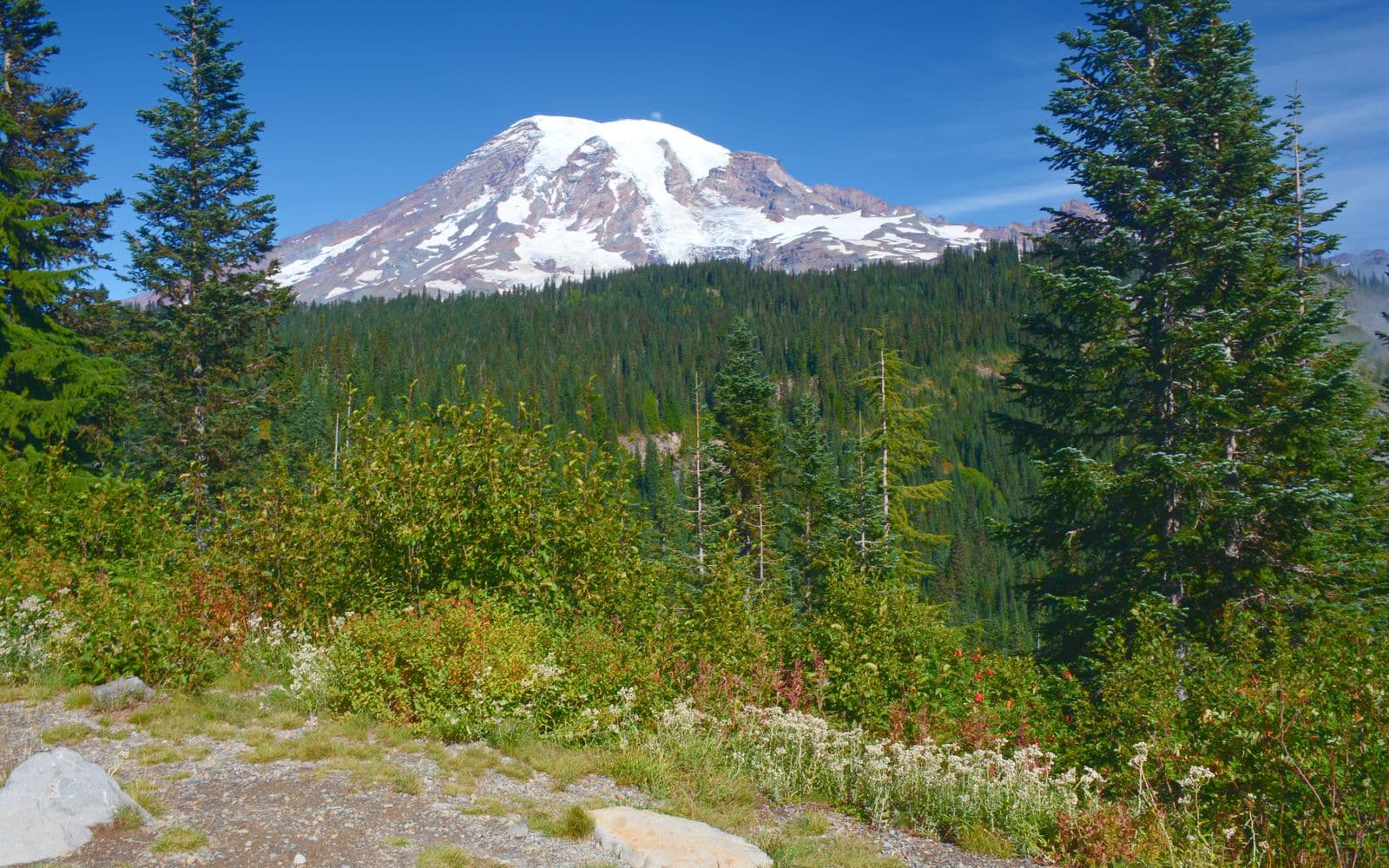
The Pacific Northwest’s best seven-day camper-van loop does not try to reach Oregon. It uses Seattle as the gateway, gives Mount Rainier a real day, then circles Olympic National Park through alpine ridge, rainforest and Pacific coast.
Olympic is not one compact valley: Port Angeles, the Hoh and Kalaloch are separated by long, slow roads. The route works only when the overnight bases follow that geography.
- 1
Seattle
- 2
Mount Rainier
Drive from previous stop: 2 hr 30
- 3
Port Angeles
Drive from previous stop: 3 hr 30
- 4
Hurricane Ridge
Drive from previous stop: 40 min
- 5
Hoh Rain Forest
Drive from previous stop: 3 hr 30
- 6
Kalaloch Coast
Drive from previous stop: 1 hr 30
- 7
Seattle
Drive from previous stop: 3 hr 30
Schematic route by Roam Wired. Drive times are planning estimates; traffic, weather and vehicle restrictions can change them.
Route at a glance
| Day | Overnight base | Main plan | Approximate drive |
|---|---|---|---|
| 1 | Rainier gateway | Collect in Seattle and reach camp | 90–120 miles / 2.5–3.5 hours |
| 2 | Rainier gateway | Paradise or Sunrise region | Local driving |
| 3 | Port Angeles | Transfer around Puget Sound | 150–190 miles / 3.5–5 hours |
| 4 | Port Angeles | Hurricane Ridge and Lake Crescent | 40–80 local miles |
| 5 | Hoh area | Sol Duc or Hoh Rain Forest | 90–120 miles / 2.5–4 hours |
| 6 | Kalaloch | Rainforest and Pacific beaches | 40–70 miles / 1.5–3 hours |
| 7 | Seattle | Return through Olympia | 175–200 miles / 3.5–5 hours |
Book in this order
- Rainier camping for the correct park side.
- Hoh or Kalaloch during their reservation seasons.
- Port Angeles or Heart O’ the Hills.
- A compact van with enough included mileage.
- A final-day return slot that tolerates traffic.
Compare Seattle camper van rentals. Check whether pickup is in Seattle proper, Tacoma, Everett or the Eastside; airport delivery and bridge travel can change day one significantly.
The seven-day itinerary
Day 1: Seattle to Mount Rainier
Collect before midday if possible. Test water, propane, refrigerator, heating, battery charging and waste equipment before leaving the metro area. Buy groceries and record the vehicle height.
Choose the first campground according to the next day’s destination. Cougar Rock serves the Nisqually/Paradise side; White River serves the northeast/Sunrise side when open. Do not cross the park late merely because two points look close on a map.
Day 2: Mount Rainier
Mount Rainier does not require timed entry in 2026, but entrance lines and full parking remain possible. Start early, use one region and keep a lower-elevation alternative if cloud hides the mountain.
The same official guidance confirms Ohanapecosh Campground is closed throughout 2026. Cougar Rock and White River operate during their summer seasons, subject to conditions. None of the park campgrounds provides campsite hookups; verify water and dump facilities separately.
Avoid scheduling a summit-view hike as if weather were guaranteed. Waterfalls, forest trails and visitor-center stops make better backups.
Day 3: Rainier to Port Angeles
This is a transfer day. The all-road route around Puget Sound avoids ferry uncertainty; a ferry can be scenic but requires schedule, vehicle-length and queue planning. Do not assume the navigation app’s ferry time includes check-in or waiting.
Set up around Port Angeles or Heart O’ the Hills. Shop and refuel before the west side, where services become sparse.
Day 4: Hurricane Ridge and Lake Crescent
Drive Hurricane Ridge Road only when open and current restrictions permit. Olympic’s conditions page says overnight camping is prohibited in Hurricane Ridge parking lots and some side roads are unsuitable for RVs, trailers or buses.
Use the ridge early, then return for Lake Crescent or a short forest walk. Keep drinking water in the van; construction and seasonal operations can limit services at the ridge.
Day 5: Port Angeles to the Hoh
Break the drive around Lake Crescent or Sol Duc, then continue west. The Hoh entrance can develop long waits in summer; NPS recommends arriving before 8 a.m. or after 5 p.m. at the busiest times. A campground reservation does not guarantee immediate trailhead parking.
Hoh Campground requires reservations for the published summer 2026 period. Sites commonly favor shorter vehicles, with only a limited number accommodating longer RVs.
Day 6: Hoh Rain Forest to Kalaloch
Walk the rainforest early, then move south to the coast. Kalaloch is the most logical final Olympic base because it shortens the Seattle return and provides access to beaches and coastal forest.
Check tide, surf and driftwood hazards before beach time. Never stand on logs in moving water. Keep food and scented products secured according to park instructions.
The official Olympic camping guide lists Kalaloch reservations as required from May 15 to September 20, 2026, and Hoh reservations from June 12 into early September. Check the live page because operating dates can change.
Day 7: Kalaloch to Seattle
Return through Aberdeen and Olympia. This is a substantial drive before fuel, cleaning and handback. Add at least 90 minutes to the map estimate and avoid booking an early flight.
If the return appointment is in the morning, spend night six nearer Olympia rather than on the coast.
Should you add Portland and Oregon?
Not in seven days. Portland and the Oregon coast deserve a separate week. Adding them here removes the Hoh or turns the final two days into continuous driving.
For nine or ten days, continue from Kalaloch to Astoria, spend two coastal nights and return from Portland only if the rental permits a one-way drop. Price that fee before booking flights.
Campsite strategy
| Area | 2026 consideration | Vehicle note |
|---|---|---|
| Rainier | Ohanapecosh closed; use Cougar Rock or White River | Verify the correct side of the mountain |
| Port Angeles | Heart O’ the Hills is a useful base | Longer sites are limited |
| Hoh | Summer reservation period | Many sites suit vehicles around 21 feet |
| Kalaloch | Reservations required in peak season | Some longer sites, not unlimited |
Trailheads, beach pullouts and Hurricane Ridge are day-use areas, not substitute campsites. Camp only where overnight vehicle occupation is explicitly allowed.
Which camper van should you rent?
| Vehicle | Best for | Trade-off |
|---|---|---|
| Minivan camper | Two people in settled summer weather | Wet-weather living is cramped |
| Compact Class B | Best overall PNW choice | Higher nightly price |
| Small Class C | Families needing a bathroom | Fewer campsites and harder trailhead parking |
| Large RV | Static commercial RV parks | Poor fit for this national-park loop |
A compact van with reliable heating is more valuable than four-wheel drive for most paved itineraries. Confirm awning use, generator hours, ferry classification, chains and gravel-road exclusions.
Seasonal trade-offs
- May–June: waterfalls and green forest; mountain roads and campgrounds may still be limited.
- July–August: best high-country access and highest demand.
- September: often an excellent balance, with colder nights and shorter days.
- October–April: rain, snow and closures reshape the trip; keep to lower elevations.
Rain is part of the region. Choose a vehicle in which everyone can cook, change wet clothing and sleep without leaving doors open. Dry damp gear before it becomes a seven-day condensation problem.
Seven-day budget for two
| Item | Planning range |
|---|---|
| Van, protection and service fees | $1,500–$2,700 |
| Fuel for 750–900 miles | $240–$420 |
| Six campground nights | $150–$480 |
| Park, ferry and reservation costs | $80–$220 |
| Food and contingency | $350–$650 |
| Indicative total | $2,320–$4,470 |
Use the US rental-cost guide to compare the live checkout total, mileage allowance and protection.
Common planning failures
- Treating Olympic as one destination rather than several separate regions.
- Building the 2026 route around closed Ohanapecosh Campground.
- Assuming no Rainier timed entry means parking is guaranteed.
- Taking a long RV to sites selected for a 21-foot van.
- Sleeping in Hurricane Ridge or beach parking.
- Adding Portland to a seven-day loop.
- Returning from Kalaloch immediately before a flight.
Start with Seattle rentals, compare Olympic National Park camper vans, and use Mount Rainier rentals when a gateway pickup reduces the first transfer.
Plan the booking
Compare camper van pickup locations for this trip
Choose the handover point that fits the route, then compare the complete checkout price, mileage allowance and first-night logistics.
Frequently Asked Questions
Keep the build moving
Make the next build decision easier.
Get practical diagrams, calculator updates and honest product comparisons in your inbox.
Jack Kennedy is a self-builder who has built two vans. He created Roam Wired to simplify conversion planning and share free tools, supported by affiliate links.
About Jack