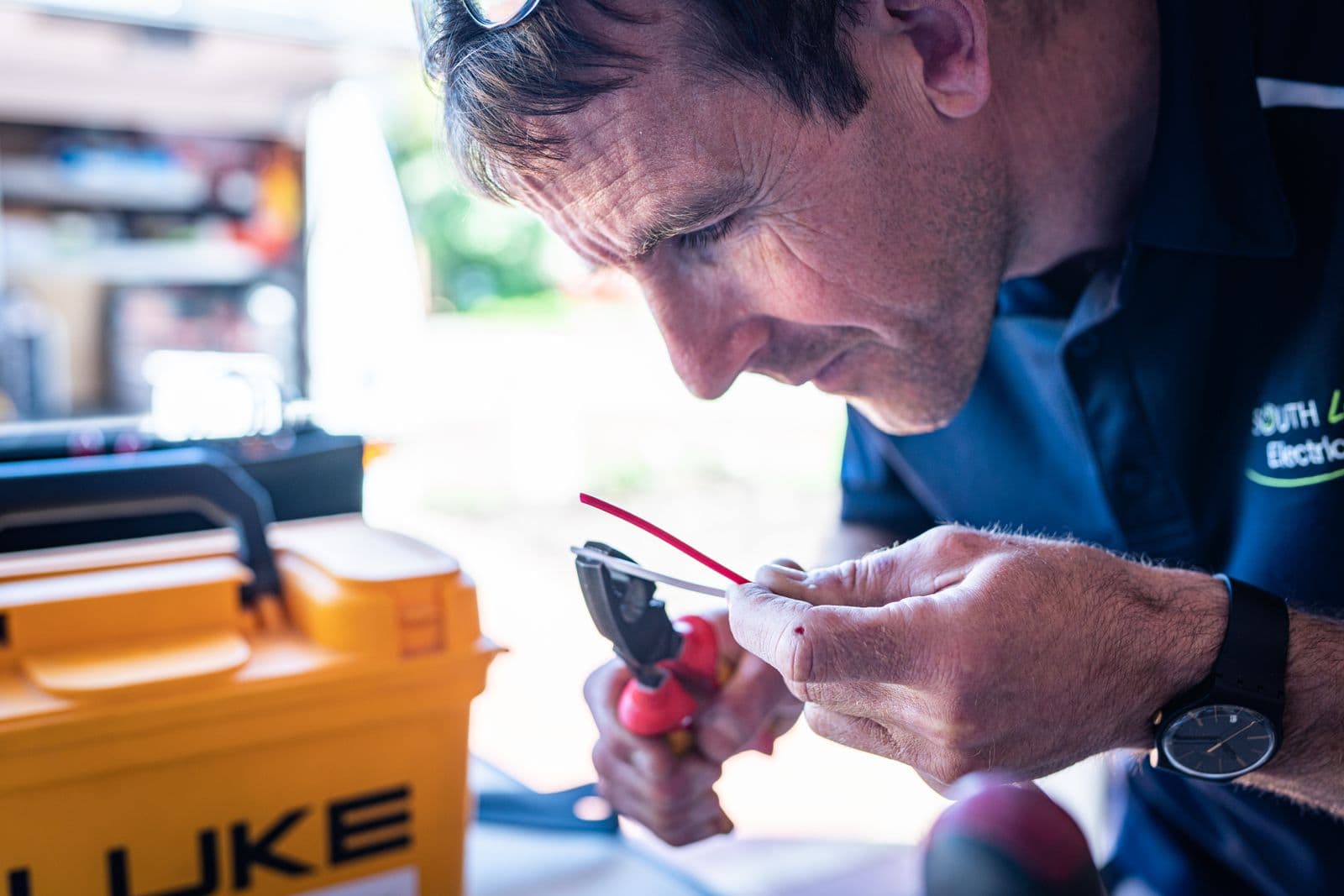
Earthing is the part of campervan wiring that most guides gloss over — and it is the part most likely to kill you if it goes wrong. A correctly earthed van protects you from electric shock, prevents stray currents that destroy battery terminals, and ensures your RCD can actually trip when it needs to.
This guide covers both the 12V DC earth system and the 230V AC protective earth, how they interact, and exactly how to bond them safely. For the broader context, see our campervan wiring safety guide and the consumer unit wiring guide for 230V-specific earthing.
Design a safe electrical system
Our free calculator sizes every component — including cable gauges for earth connections — based on your actual loads.
Why Earthing Matters
In a house, the earth is a buried rod that provides a low-resistance path for fault current. If a live wire touches a metal appliance case, the fault current flows through the earth wire, trips the breaker, and you are safe.
In a campervan, there is no buried rod. Your earth reference is the van's metal chassis — and when connected to a campsite bollard, the earth path extends back through the hook-up cable to the site's earthing system.
Get this wrong and three things can happen:
- Electric shock — a fault on a 230V appliance leaves the casing live. You touch it. Without a proper earth path, the RCD cannot detect the fault current and does not trip.
- Electrolytic corrosion — stray DC currents flowing through the chassis eat through battery terminals, fittings, and metalwork over months.
- Fire — a poor earth connection creates resistance. Resistance under fault current creates heat.
The Two Earth Systems in Your Van
12V DC Earth (Chassis Earth)
Every 12V appliance in your van needs a return path for current. The conventional approach — and the right one for campervans — is to use the van's metal chassis as the negative return conductor.
This is called a single-wire earth return system. Your battery negative connects to the chassis at a single clean point. All 12V appliance negatives connect either directly to the chassis (using a short earth lead to the nearest suitable metal) or back to a negative bus bar that itself connects to the chassis.
The critical rule: one main chassis earth point from the battery negative. Multiple paths to the same chassis point are fine; multiple paths with long loops back to the battery are not.
230V AC Protective Earth (PE)
The 230V system uses a dedicated green/yellow earth conductor that runs alongside every live and neutral wire. This earth connects:
- The earth pin of your shore power inlet
- The earth terminal bar in your consumer unit
- The earth pin of every 230V socket
- The chassis of every hardwired 230V appliance
The 230V protective earth and the 12V chassis earth must be bonded together — connected at a single point — in your consumer unit or at the battery negative bus bar. This is called equipotential bonding and it ensures both systems share the same voltage reference.
Bond the two earth systems once, at one point
Connect the 230V protective earth to the 12V chassis earth at exactly one point. Multiple connections create earth loops that allow stray currents to flow, causing corrosion and interference. One connection, done properly, is correct. Two connections create a problem.
How to Earth the 12V System
Step 1: Choose Your Main Earth Point
Find a clean, unpainted section of the van's structural chassis — a chassis rail or floor crossmember, not a panel. The point should be:
- Close to your battery (ideally within 50cm)
- On bare metal, free of paint, underseal, or rust
- Accessible for future inspection
Step 2: Prepare the Surface
Use a wire brush or angle grinder to remove paint and surface rust from a 30mm diameter area. You want shiny bare metal. Apply petroleum jelly (Vaseline) around the contact area after fitting the terminal — this prevents re-oxidation.
Step 3: Fit the Earth Lug
Use a ring terminal crimped onto your battery negative cable. The terminal must be the correct size for your cable gauge — see our wire gauge guide for sizing. Use a stainless steel bolt, spring washer, and flat washer. Torque it firmly. Check it annually — vibration loosens earth connections.
Step 4: Negative Bus Bar
For a tidy installation with multiple 12V circuits, run a single heavy cable from battery negative to a negative bus bar, then run individual circuit returns from the bus bar. The bus bar itself gets one earth lead to the chassis. This is neater and easier to fault-find than multiple cables bolted to the chassis at different points.
How to Earth the 230V System
The Shore Power Inlet
Your CEE blue hook-up socket has three connections: live (L), neutral (N), and earth (E). The earth pin connects via a green/yellow conductor to your consumer unit earth terminal bar. Use 2.5mm² green/yellow cable — the same gauge as your live and neutral.
Consumer Unit Earth Bar
Inside your consumer unit, an earth terminal bar (sometimes called a PE bar) collects all incoming and outgoing earth conductors:
- Incoming earth from shore power inlet
- Earth to each 230V socket
- Earth to each hardwired appliance
- Bonding conductor to chassis/12V earth
Every connection must be tight. Earth connections that work loose are invisible until there is a fault.
Bonding Exposed Metalwork
Any metal part that could become live if a 230V fault occurred must be bonded to the earth bar. In practice this means:
- Metal consumer unit enclosure (if used)
- Metal socket mounting boxes
- Metal appliance housings (hardwired oven, water heater, etc.)
Use 4mm² green/yellow cable for supplementary bonding conductors to large metal masses.
Common Earthing Mistakes
Using Paint-Covered Metal
Paint is an insulator. An earth bolt tightened onto painted chassis rail has almost no electrical contact. Sand it back to bare metal.
Undersized Earth Cables
Earth conductors must be able to carry full fault current long enough for the RCD to trip — typically 30-50ms. Your earth cable must be at least as large as the largest live conductor it protects. For a 16A socket circuit on 2.5mm² cable, use 2.5mm² earth.
Relying on the Van Body as the Only Earth
The van body has welded and bolted joints throughout. Each joint adds resistance. A current path that goes through three body panels and two spot-welded seams is not a reliable earth — it is an accident waiting to happen. Always run a dedicated earth conductor back to your main earth point.
Multiple 12V/230V Bonding Points
As mentioned above — bond the two earth systems once. A second bonding point creates a loop. Earth loops allow induced currents (from alternator, inverter, or nearby appliances) to circulate, causing interference on audio/video equipment and accelerating corrosion.
Not Testing After Installation
Use a multimeter in continuity mode to verify every earth connection after installation. Probe from the earth pin of each socket back to the chassis earth point. Resistance should be less than 1 ohm for the entire path. Anything over 2 ohms needs investigation.
Earth Fault Loop Impedance
If you want to go further — and you should if your 230V system will be used regularly — measure the earth fault loop impedance (EFLI) at each socket. This tells you whether the earth path is low-resistance enough for the RCD to trip within 40ms under a fault condition.
A simple socket tester with EFLI measurement costs £30-£60 and takes two minutes per socket. Any reading under 1667 ohms is acceptable for a 30mA RCD (though in practice you want far lower — under 100 ohms is achievable in a well-wired van).
Get an Electrical Installation Certificate
A qualified electrician can test your complete earth system, measure EFLI at every outlet, and issue an Electrical Installation Certificate. This costs £50-£150 and provides documented proof that your earthing is safe — valuable for insurance purposes.
Summary: Earth Bonding Checklist
- Battery negative connected to chassis at one clean, bare-metal point
- All 12V circuit returns via negative bus bar (not multiple chassis points)
- Shore power inlet earth (green/yellow 2.5mm²) to consumer unit PE bar
- All 230V socket earth conductors terminated at consumer unit PE bar
- PE bar bonded to 12V chassis earth at one point only
- All exposed metal appliance housings bonded to PE bar
- All earth connection surfaces bare metal, treated with petroleum jelly
- Continuity tested (<1 ohm) at every earth point after installation
FAQ
Does my campervan need an earth rod?
No. A campervan earths through the hook-up cable when connected to shore power. When off-grid, your 12V system earths through the chassis, and the RCD protects the 230V system. An earth rod is not practical or required.
Can I use the van body as my 12V earth return instead of running cables?
Yes, but only if you make a proper connection to bare metal and your return path does not pass through multiple bolted/welded joints. A dedicated earth cable from each appliance to a central bus bar is more reliable and easier to fault-find.
What gauge cable for the main chassis earth?
Match it to your battery negative cable — typically 35mm² or 50mm² for a serious leisure system. The main chassis earth carries the return current for your entire 12V system, so undersizing it causes voltage drop and heat.
My inverter has a separate earth terminal — should I connect it?
Yes. Connect the inverter's earth terminal to your 12V chassis earth. This bonds the inverter chassis to the earth reference and allows the RCD to detect faults on the inverter's 230V output side.
Related
Keep the build moving
Make the next build decision easier.
Get practical diagrams, calculator updates and honest product comparisons in your inbox.
Roam Wired
Roam Wired turns campervan research into practical plans. We publish transparent guidance, a free electrical design tool and marketplace resources for UK and US van builders.
About our approach