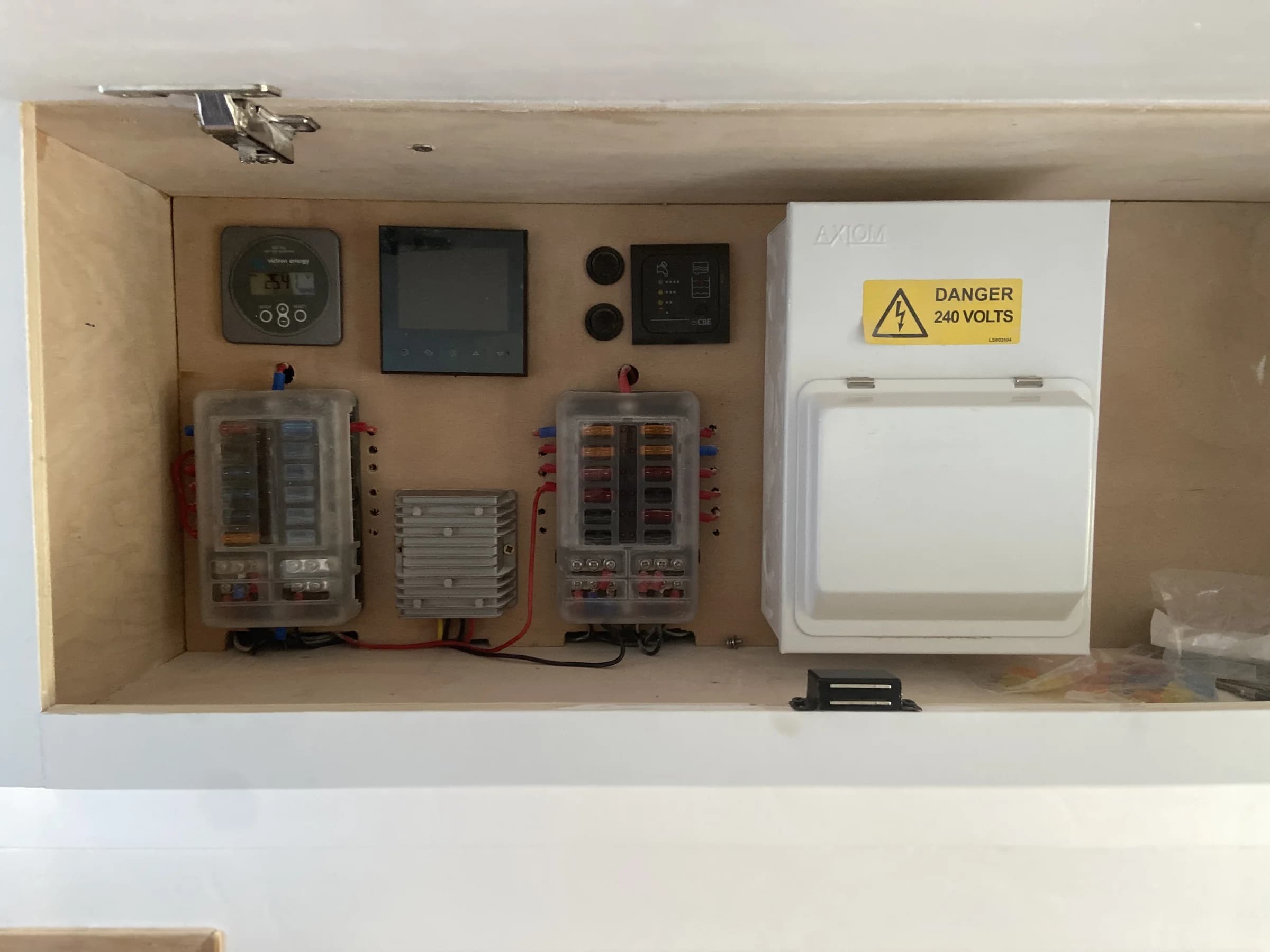
The consumer unit is the heart of your campervan's 230V mains system. It is the first thing the incoming mains supply passes through, and it protects you from electric shock, fire, and overload. Getting it right is not optional — it is a safety requirement and, in many cases, a legal one. This guide explains what a consumer unit is, how to wire one correctly, and how UK regulations apply to campervan conversions.
Understanding the consumer unit is a critical part of building a safe campervan charging system, because your mains charger and any 230V sockets depend on it. If you are still planning your overall electrical layout, the VanPower calculator helps you size the system and shows what components you need.
What Is a Consumer Unit?
A consumer unit (sometimes called a distribution board or fuse board) is a box containing safety devices that distribute and protect your 230V circuits. In a house, it is the large grey or white box near your front door. In a campervan, it is a smaller version typically mounted under a seat, in a wardrobe, or behind a panel — accessible for maintenance but protected from water and accidental contact.
What Goes Inside
A typical campervan consumer unit contains:
- Main switch or isolator: Disconnects all 230V power with a single action
- RCD (Residual Current Device): Detects earth leakage and trips to prevent electric shock
- MCBs (Miniature Circuit Breakers): Protect individual circuits from overload and short circuit
Some units combine the main switch and RCD into a single device called an RCBO (Residual Current Breaker with Overcurrent protection), or use an RCD as the main switch.
RCD Protection: Your Life-Saving Device
What an RCD Does
An RCD continuously monitors the balance between current flowing out on the live wire and current returning on the neutral wire. If there is a difference — meaning current is leaking to earth, possibly through a person — the RCD trips within 30 milliseconds. This is fast enough to prevent fatal electrocution in most circumstances.
RCD Specifications for Campervans
- Sensitivity: 30mA (this is mandatory — do not use a 100mA or 300mA RCD for personal protection)
- Type: Type A or Type AC. Type A is preferred because it detects both AC and pulsating DC fault currents (common with modern electronic devices and inverter/chargers)
- Rating: Must be equal to or greater than the incoming supply. A 40A RCD covers all UK campsite hook-ups (which are 6A, 10A, or 16A)
- Poles: Double-pole (breaks both live and neutral). This is important because some campsites have reversed polarity — a single-pole RCD might not break the live conductor if polarity is reversed
30mA RCD Is Non-Negotiable
A 30mA RCD is the minimum standard for personal shock protection in the UK. It is required by BS 7671 (the IET Wiring Regulations) for mobile installations. Do not substitute it with a higher-rated device, and do not omit it. Without an RCD, a fault in your 230V system could kill you or a passenger.
Testing Your RCD
Every RCD has a test button. Press it monthly — the RCD should trip instantly. If it does not trip, the device is faulty and must be replaced before you use the 230V system again. Also test it every time you connect to a new hook-up, as site wiring quality varies.
MCBs: Circuit Protection
What MCBs Do
An MCB (Miniature Circuit Breaker) protects a circuit from overcurrent — either from an overload (too many appliances) or a short circuit (a wiring fault). When current exceeds the MCB's rating, it trips and disconnects the circuit.
MCB Sizing for Campervans
MCB ratings must match the cable size and circuit purpose:
| Circuit | Typical MCB Rating | Cable Size |
|---|---|---|
| 230V sockets | 16A (Type B) | 2.5mm² |
| Battery charger | 6A or 10A (Type B) | 1.5mm² |
| Fixed appliances | 6A or 10A (Type B) | 1.5mm² |
| Lighting (if 230V) | 6A (Type B) | 1.0mm² or 1.5mm² |
Type B MCBs are standard for most domestic and vehicle circuits. They trip at 3-5 times their rated current, which suits the resistive and lightly inductive loads found in a campervan.
How Many MCBs Do You Need?
Most campervans need only two or three circuits:
- Sockets circuit: Powers all 230V double sockets in the van. Protected by a 16A MCB.
- Charger circuit: Powers the mains battery charger. Protected by a 6A or 10A MCB.
- Fixed appliance circuit (optional): For a permanently wired appliance like a Truma heater or air conditioning unit. Protected by a suitably rated MCB.
You can run the charger and sockets from a single MCB if the combined load does not exceed the MCB's rating, but separate circuits give you independent fault isolation — if a socket trips, the charger keeps working.
Choosing a Consumer Unit
Purpose-Built Campervan Units
Several companies make consumer units specifically designed for campervans and motorhomes:
- CBE consumer units (~£40-£80): Popular in European motorhomes, compact, available with 2-4 ways
- Votronic units (~£50-£90): German-made, high quality, common in self-builds
- Bespoke enclosures with DIN-rail components (~£30-£60 for the enclosure plus £10-£20 per component): Build your own from standard DIN-rail RCDs and MCBs
Using Standard Domestic Components
You can also use standard UK domestic consumer unit components (Wylex, MK, Hager) mounted on a DIN rail in a suitable enclosure. This is often cheaper and gives you more flexibility. A small plastic DIN-rail enclosure (4-6 modules wide) costs £10-£15, an RCD costs £20-£35, and MCBs cost £5-£10 each.
DIN-Rail Makes Life Easy
All modern RCDs and MCBs clip onto a standard 35mm DIN rail. Buy a small IP65-rated enclosure with a DIN rail inside, clip in your RCD and MCBs, and you have a consumer unit. This approach is cheaper than a purpose-built campervan unit and uses readily available components from any electrical wholesaler.
Wiring the Consumer Unit: Step by Step
Before You Start
- Switch off and disconnect all 230V power
- Have the correct tools: insulated screwdrivers, wire strippers, cable cutters, and a multimeter
- Use the correct cable: 2.5mm² twin-and-earth for socket circuits, 1.5mm² for lighting and low-power circuits
- Follow the UK wiring colour codes so live, neutral, and earth are correctly identified at every connection
- Plan your cable routes to avoid water ingress points, gas pipes, and 12V wiring
Step 1: Mount the Consumer Unit
Choose a location that is:
- Accessible for maintenance and testing (you need to reach the RCD test button and MCB switches)
- Protected from water splashes and condensation
- Away from gas appliances and their flues
- Ventilated to dissipate any heat from the RCD and MCBs
- Ideally within 1 metre of the shore power inlet to keep the incoming cable short
Mount the unit securely to a structural part of the van (a panel, a frame member, or a purpose-built bracket). It should not come loose under vibration.
Step 2: Wire the Incoming Supply
The cable from your shore power inlet enters the consumer unit and connects to the main switch or RCD:
- Route 2.5mm² three-core flex (live, neutral, earth) from the shore power inlet to the consumer unit
- Strip and prepare the cable ends
- Connect live (brown) to the RCD/main switch live input terminal
- Connect neutral (blue) to the RCD/main switch neutral input terminal
- Connect earth (green/yellow) to the earth terminal bar
Step 3: Wire the RCD Output to MCBs
The RCD's output feeds the MCBs:
- Run a short live busbar or link wire from the RCD live output to the MCB live input terminals
- Run a short neutral link from the RCD neutral output to the neutral busbar (which feeds all circuit neutrals)
- Each MCB feeds one circuit
Step 4: Wire the Outgoing Circuits
From each MCB, cable runs to the circuit it protects:
- Socket circuit: 2.5mm² cable from the MCB to each 230V socket in a radial configuration (one cable running from socket to socket)
- Charger circuit: 1.5mm² cable from the MCB to the battery charger's mains input
- Connect the neutral wire of each circuit to the neutral busbar
- Connect the earth wire of each circuit to the earth terminal bar
Step 5: Earth Bonding
All exposed metalwork in the 230V installation must be bonded to the earth terminal bar. This includes:
- Socket mounting plates (if metal)
- The consumer unit enclosure (if metal)
- Any metal appliance housings connected to the 230V system
The van body itself is earthed through the hook-up cable's earth conductor, which connects to the site's earthing system.
Do Not Rely on Van Body Earth Alone
Unlike a house, a campervan does not have a permanent earth rod. Your earth connection comes through the hook-up cable. If the cable is disconnected, you have no earth. This is why an RCD is so critical — it provides protection even if the earth path is compromised. Never assume the van body provides adequate earthing for the 230V system.
UK Regulations: What Applies to Campervans?
BS 7671 (IET Wiring Regulations)
The primary UK standard for electrical installations is BS 7671, also known as the IET Wiring Regulations. Section 708 specifically covers "Electrical Installations in Caravan/Camping Parks and Similar Locations," and Section 721 covers "Electrical Installations in Caravans and Motor Caravans."
Key requirements from Section 721 include:
- 30mA RCD protection is mandatory
- The supply inlet must be a blue CEE connector complying with BS EN 60309-2
- All circuits must have overcurrent protection (MCBs)
- Cable must be rated for flexible installation and the expected temperatures
- A main isolating switch must be provided
Is It a Legal Requirement?
For a vehicle sold commercially as a motorhome, the 230V system must comply with BS 7671. For a personal self-build, there is no legal inspection requirement — but if your van is involved in an accident or an insurance claim, a non-compliant installation could void your cover and potentially lead to prosecution.
In short: build to the standard whether or not you are legally required to. It exists to protect your life.
NICEIC / Part P
Unlike domestic installations, campervan 230V wiring does not fall under Part P of the Building Regulations (which requires notification to Building Control). However, having your installation inspected by a qualified electrician and receiving an Electrical Installation Certificate (EIC) is strongly recommended — it provides documented proof that your system is safe and compliant.
Common Mistakes to Avoid
Using Domestic Socket Faceplates in a Wet Environment
Standard UK double sockets (BS 1363) are designed for dry indoor use. In a campervan, where condensation and humidity are constant, consider IP-rated sockets or mount standard sockets in dry, well-ventilated locations.
Undersizing Cable
Never use 1.0mm² cable for a socket circuit. The minimum for a 16A socket circuit is 2.5mm². For runs over 10 metres, consider the voltage drop and upsize if necessary.
Forgetting the Double-Pole Switch
Some site bollards have reversed polarity. If your main switch only breaks the live conductor, the "neutral" (which is actually live in reverse polarity) remains energised even when the switch is off. Use a double-pole main switch or double-pole RCD to break both conductors simultaneously.
Not Testing After Installation
Every new installation should be tested with a multimeter (checking for continuity, insulation resistance, and polarity) and functionally tested (plug in and check everything works, trip the RCD, trip each MCB).
Plan Your 230V System
Our free calculator helps you determine what circuits you need, what MCB sizes to use, and how the consumer unit fits into your overall campervan electrical design.
Frequently Asked Questions
Can I use an RCBO instead of a separate RCD and MCB?
Yes. An RCBO combines RCD and MCB functions in one device. You could use one RCBO per circuit, eliminating the need for a separate RCD. This is more expensive but gives each circuit independent earth-leakage protection. For most campervans with only 2-3 circuits, a single RCD feeding multiple MCBs is simpler and cheaper.
Do I need an earth rod?
No. A campervan uses the earth provided by the hook-up cable from the campsite bollard. An earth rod is not practical or required. The 30mA RCD provides protection if the earth path is lost.
What if the campsite RCD keeps tripping?
Some older or cheaper campsites have sensitive or faulty RCDs on their bollards. If the site RCD trips when you connect, try a different bollard. If it trips consistently, there may be an earth leakage fault in your van's wiring — unplug, isolate each circuit by switching off MCBs, and reconnect one circuit at a time to identify the faulty one.
How often should I test the consumer unit?
Test the RCD monthly using the built-in test button. Visually inspect wiring connections annually — vibration from driving can loosen terminal screws over time. Re-torque all connections once a year.
Can I add circuits later?
Yes, if your consumer unit has spare MCB positions. This is why buying a 4-way or 6-way enclosure (even if you only use 2-3 positions initially) is good practice. Adding an MCB and running new cable is straightforward.
Do I need a professional electrician?
It is not legally required for a self-build, but it is strongly recommended. A qualified electrician can inspect your work, test the installation, and issue an Electrical Installation Certificate. This costs £50-£150 and provides peace of mind — plus evidence of compliance for insurance purposes.
Related
Keep the build moving
Make the next build decision easier.
Get practical diagrams, calculator updates and honest product comparisons in your inbox.
Roam Wired
Roam Wired turns campervan research into practical plans. We publish transparent guidance, a free electrical design tool and marketplace resources for UK and US van builders.
About our approach