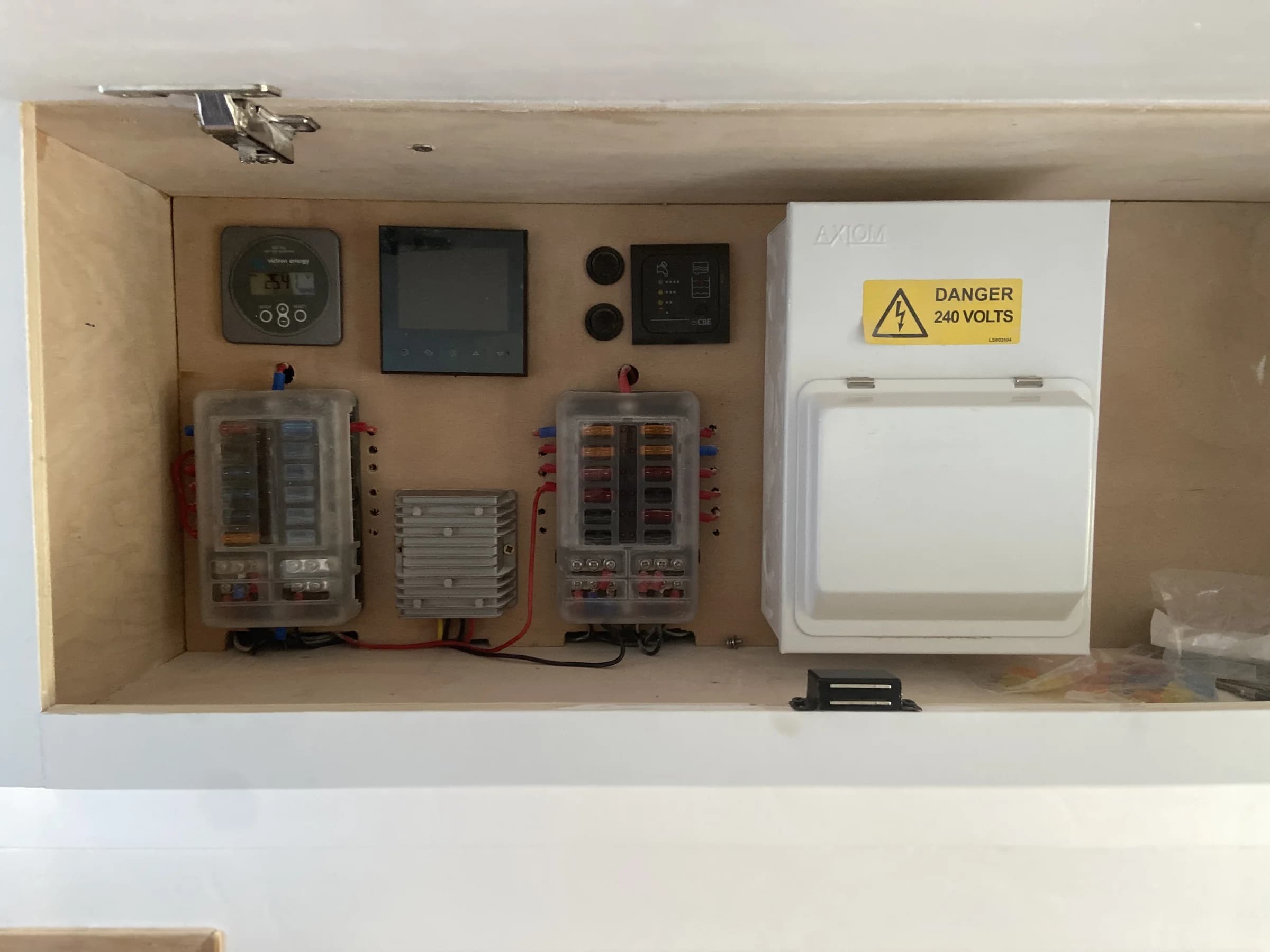
A well-organised electrical panel makes a van build look professional, simplifies fault-finding, and makes adding circuits later straightforward. Here is how to design and install one for a UK campervan.
Two approaches to 12V distribution
Blade fuse box
A car-style blade fuse box accepts standard ATO/ATC blade fuses (the same type as a car's fusebox). Available with 4 to 32 circuits, with or without built-in bus bars.
Advantages:
- Familiar format — easy to understand
- Low cost (£10–40 for a quality unit)
- Fuses easy to replace
- Compact
Disadvantages:
- Individual circuit cannot be switched without removing the fuse
- Maximum circuit rating typically limited to 30A per circuit
- Some cheap fuse boxes have poor-quality connectors that corrode
Best choices: Blue Sea 5025 (12 circuits), Victron fuse box, Hella fuse box, or BEP Marine fuse panels. Avoid very cheap unbranded units from AliExpress — contact resistance causes voltage drop and heat.
DIN rail MCBs (miniature circuit breakers)
DIN rail breakers are the same format as domestic consumer units. They are mounted on a standard 35mm DIN rail and snap on and off easily.
Advantages:
- Each circuit can be switched off (the breaker acts as a switch)
- Resettable after a trip — no replacement fuses needed
- Professional appearance
- Easy to add or remove circuits
- Clearly labelled with amperage on each breaker
Disadvantages:
- Takes more space than a blade fuse box
- More expensive per circuit (£3–10 per breaker vs pennies for a blade fuse)
- Requires a DIN rail enclosure or custom housing
Common in professional van conversions. A small consumer unit housing (available from electrical wholesalers) provides a ready-made enclosure for the DIN rail, bus bars, and breakers.
Sizing the main feed to the panel
The main positive cable from your bus bar to the fuse box/panel should be rated for the total current all circuits might draw simultaneously. Add up the maximum current for every circuit and use that as your fuse box feed rating.
Example:
- 2× LED lighting circuits (10A each) = 20A
- Fridge (10A) = 10A
- Water pump (8A) = 8A
- Diesel heater (5A) = 5A
- 3× USB charging circuits (5A each) = 15A
- Fan (5A) = 5A
- Total: 63A
Main fuse box feed: 70A fuse, 16mm² cable from positive bus bar.
In practice, not all circuits run simultaneously at maximum. A 50A fuse is often adequate, but size it for the worst case.
How many circuits do you need?
Plan at least one circuit per distinct load group, and do not overload circuits.
Typical circuit list for a well-equipped campervan:
| Circuit | Fuse rating | Notes |
|---|---|---|
| Fridge | 15A | Compressor needs a higher fuse than running current |
| Lighting (zone 1 — living) | 10A | All LED strips on one circuit |
| Lighting (zone 2 — cab) | 5A | |
| Roof vent fan | 10A | MaxxAir / Dometic fans draw up to 6A |
| Water pump | 10A | |
| Diesel heater | 10A | |
| USB charging sockets | 10A | |
| 12V cigarette lighter socket | 15A | |
| Diesel heater controller | 5A | Separate from heater if wired separately |
| Spare | — | Always leave 2–3 spare circuits |
Panel location and mounting
Mount the panel in an accessible location — inside a cupboard with the door giving clear access, or behind a removable panel. The panel should be accessible without tools for checking fuses or resetting breakers.
The panel must be:
- Away from water ingress (not under a roof hatch or near the kitchen sink)
- Away from excessive heat
- Accessible for maintenance without removing other van furniture
Cable management at the panel
Neat wiring at the panel makes fault-finding much faster:
- Label every cable at both ends before connecting
- Use cable looms (bundle with spiral wrap or trunking) to route wires neatly
- Use ferrules on the ends of stranded wire before inserting into terminals (prevents stray strands)
- Leave enough cable length at the panel for connections without strain
FAQ
Do I need a negative bus bar near my fuse box?
Yes — each circuit needs a negative return. Run a main negative cable from your battery/negative bus bar to a negative distribution block near the fuse box, then connect individual circuit negatives to it.
Can I use a domestic consumer unit for 12V circuits?
Domestic MCBs are designed for 230V AC, not 12V DC. DC arc characteristics are very different — a domestic MCB will not safely interrupt a DC fault current. Use MCBs rated for DC use, or automotive/marine-specific circuit breakers for 12V circuits.
How do I prevent corrosion in connectors at the panel?
Use marine-grade connectors and apply a thin coat of dielectric grease (Vaseline or specialist electrical connector grease) to all terminal connections. Check connections annually, especially in builds where the van is washed or used in wet conditions.
Related
Keep the build moving
Make the next build decision easier.
Get practical diagrams, calculator updates and honest product comparisons in your inbox.
Roam Wired
Roam Wired turns campervan research into practical plans. We publish transparent guidance, a free electrical design tool and marketplace resources for UK and US van builders.
About our approach