Anderson plugs are the most popular quick-connect solution in the campervan world, and for good reason. They are genderless, rated for high currents, simple to wire, colour-coded, and nearly impossible to connect with reversed polarity once assembled. If you have a portable solar panel, a removable battery, or any circuit you need to connect and disconnect regularly, Anderson plugs are likely the right choice.
The four ratings must agree
This guide covers everything you need to know about selecting, wiring, and using Anderson plugs in a campervan. For specifics on connecting portable solar panels, see our portable solar panel guide. For the broader wiring picture, start with the wiring and safety guide.
Size Your Solar System First
Our free calculator determines exactly how much solar you need and what cable sizes to use. Get the right Anderson plug size by knowing your system's current requirements.
What Are Anderson Plugs?
Anderson Power Products (APP) makes a range of connectors originally designed for industrial applications — forklifts, UPS systems, and heavy electrical equipment. The design that became ubiquitous in the campervan, caravan, and off-road world is the Anderson SB series (also called PowerPole connectors for smaller sizes).
The key feature is the genderless design: both halves of the connector are identical. There is no "male" or "female" side. You simply push two identical housings together and they lock. This means you only need one type of connector in your spares kit, and any connector can mate with any other connector of the same size.
Each housing contains a metal contact that accepts one cable. Two housings (positive and negative) are keyed together to form a pair.
How Polarity Protection Works
Anderson plugs use a keying system — a physical ridge and groove moulded into the housing — that only allows two connectors to mate in one orientation. As long as you wire both sides consistently (positive to the same position on both plugs), it is impossible to accidentally reverse polarity when connecting.
Always Wire the Same Way
Establish a convention and stick to it: when looking at the flat face of the connector with the cable exiting downwards, wire positive on the left and negative on the right (or whatever you prefer — just be consistent across every Anderson connector in your build). Mark it on your wiring diagram.
Anderson Plug Sizes
Anderson connectors come in several sizes. The three you will encounter in campervan applications are:
| Model | Continuous Rating | Cable Range | Housing Size | Typical Use | UK Price (pair) |
|---|---|---|---|---|---|
| SB50 (50A) | 50A | 6-16mm2 | 58 x 40mm | Portable solar, auxiliary charging, small loads | £5-£10 |
| SB175 (175A) | 175A | 25-50mm2 | 80 x 56mm | Battery disconnect, high-current feeds, inverter input | £10-£20 |
| SB350 (350A) | 350A | 50-70mm2 | 115 x 75mm | Very high current — rarely needed in campervans | £20-£35 |
Which Size Do You Need?
For the vast majority of campervan applications, the SB50 (50A) is the right choice. It comfortably handles:
- Portable solar panels (even 400W panels draw under 30A at 12V system voltage)
- DC-DC charger connections
- Auxiliary loads up to 600W at 12V
- Battery-to-battery charging between tow vehicle and trailer
The SB175 is only needed if you are connecting or disconnecting very high-current circuits — typically a removable battery bank feeding a large inverter, or a main battery disconnect for a system drawing over 50A continuously.
The SB350 is overkill for almost every campervan build. You would only need this for commercial or competition vehicles with extreme current demands.
Anderson Plug Colour Codes
Anderson plugs are available in multiple housing colours. While there is no universal standard, the following colour conventions are widely used in the UK and Australian campervan communities:
| Colour | Common Use |
|---|---|
| Red | Main battery / high-current positive |
| Grey | General purpose / auxiliary circuits |
| Yellow | Solar panel connections |
| Blue | Auxiliary battery / secondary circuits |
| Black | General purpose / alternative |
| Green | Accessories / low-priority circuits |
The colour has no electrical function — it is purely for identification. You can mix colours however you wish. The only thing that matters is that both halves of a connection use the same colour, and that different circuits use different colours so you cannot accidentally plug your solar panel into your fridge circuit.
Different Colours Prevent Cross-Connection
A red Anderson plug will physically mate with a grey one — the colour does not prevent connection. The colours are for visual identification only. If you want to make circuits physically incompatible, you need to use different sizes (SB50 vs SB175) or use the optional keying pins that come with some Anderson connector kits.
When to Use Anderson Plugs
Portable Solar Panels
This is the single most common use of Anderson plugs in campervans. An Anderson plug mounted on the outside of your van connects to the charge controller inside. Your portable panel has a matching Anderson plug on its cable. Deploy the panel, plug it in, and solar energy flows. Disconnect and stow the panel in seconds.
For a complete guide to portable solar setups, including connection methods and panel recommendations, see portable solar panels for campervans.
Removable Battery Systems
If your leisure battery is designed to be removed — for charging at home, taking to a tent, or for security when the van is parked long-term — Anderson plugs make the disconnect and reconnect process fast and tool-free. An SB175 is typically appropriate for battery disconnects, given the higher currents involved.
Quick-Disconnect Accessories
Any 12V accessory you want to connect and disconnect without tools is a candidate for an Anderson plug:
- Portable compressor fridge
- External lighting
- Awning lights
- Electric cool box
- Auxiliary power feed to a trailer or tent
Vehicle-to-Vehicle Charging
If you tow a trailer with its own battery, or want to charge your campervan battery from another vehicle, an Anderson plug pair makes the connection straightforward. Wire one plug to each vehicle's battery (via an appropriate fuse), connect them, and the higher-voltage battery charges the lower one. A DC-DC charger on the receiving end is recommended for lithium batteries.
How to Wire an Anderson Plug
Tools and Materials
- Anderson plug pair (two housings, two contacts per pair)
- Appropriate cable (sized to the circuit — see our cable sizing guide)
- Hydraulic or ratchet crimper with the correct die for the contact size
- Wire strippers
- Heat shrink (adhesive-lined)
- Heat gun
Step-by-Step Wiring
1. Strip the cable. Strip approximately 15mm of insulation from the cable end. The exact length depends on the contact size — the bare conductor should fill the crimp barrel without protruding beyond it.
2. Crimp the contact. Insert the stripped cable into the contact's crimp barrel and crimp firmly using the correct die. The crimp must be tight and secure — pull firmly on the cable to verify. A good crimp creates a gas-tight bond.
3. Insert the contact into the housing. Slide the crimped contact into the housing until it clicks into place. The retaining spring inside the housing locks the contact — you should feel it snap in. Pull the cable gently to confirm it is locked.
4. Repeat for the second conductor. Strip, crimp, and insert the second cable into the second housing.
5. Join the housings. Slide the two housings together. They are keyed and will only go together one way.
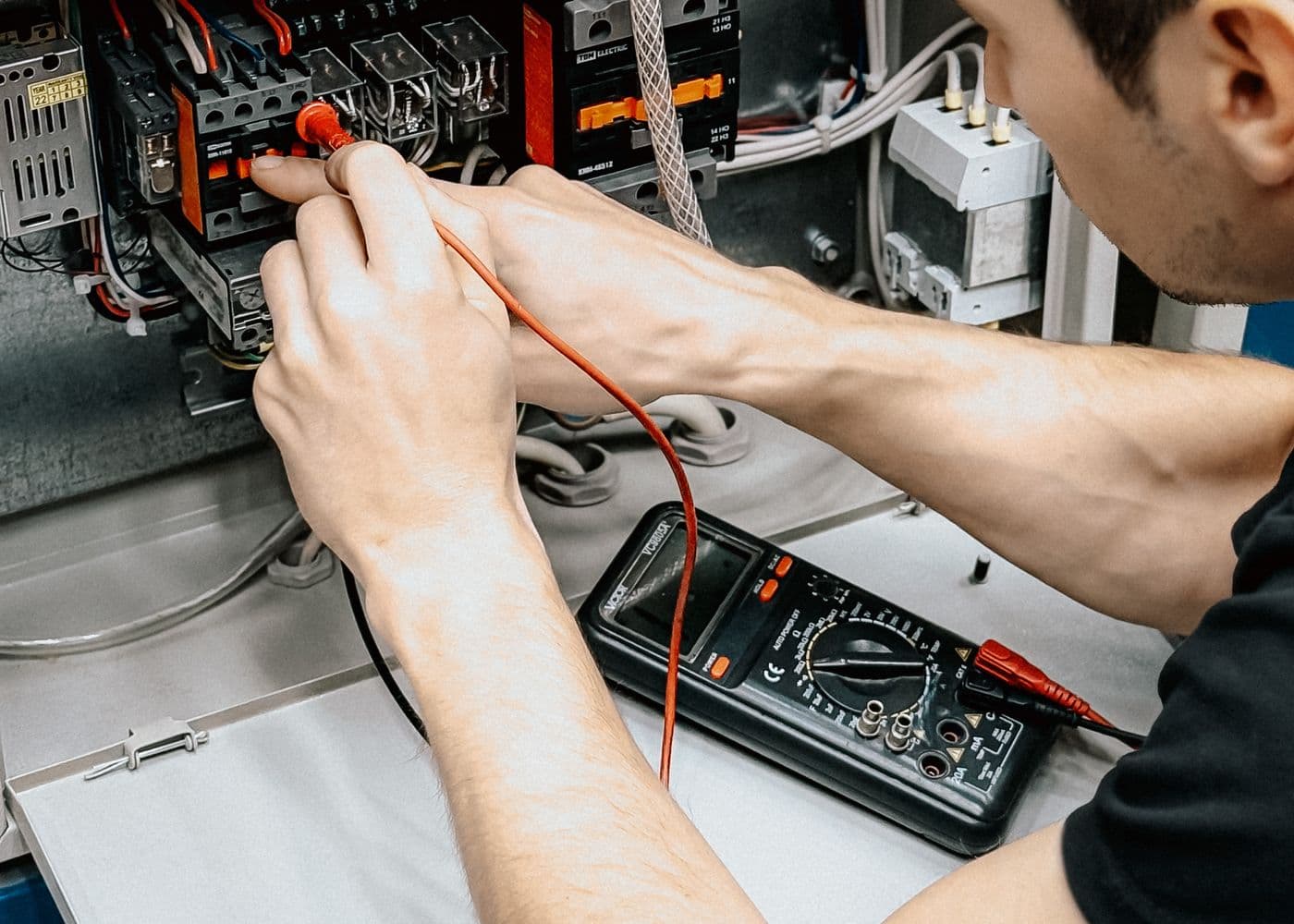
6. Test. Use a multimeter to verify continuity from cable end to contact face, and check there is no short between positive and negative.
Use the Correct Crimp Die
Anderson contacts have a specific crimp barrel size that must match your crimper's die. Using the wrong die produces a loose or deformed crimp that will overheat under load. SB50 contacts typically use a 10-12mm2 die, but check the datasheet for your specific contact and cable combination.
Mounting an External Anderson Plug
For a permanent external connection point (solar input, auxiliary output), mount the Anderson plug through the van wall:
- Drill or cut a hole in the van wall at the desired location — typically on the side wall near the solar charge controller, or at the rear near the battery compartment
- Fit a surface-mount Anderson plug bracket (available for £5-£10, designed to hold an SB50 or SB175 in a neat flush-mount housing)
- Seal the mounting with marine sealant (Sikaflex or CT1) to prevent water ingress
- Wire the internal cable from the bracket to the charge controller, fuse box, or bus bar as appropriate
- Fuse the circuit — always fuse the positive cable as close to the battery as possible
Weatherproof covers (dust caps) are available for Anderson plugs and are highly recommended for any externally mounted connector.
Anderson Plugs vs Other Connectors
| Connector | Current Rating | Polarity Protection | Weatherproof | Cost (pair) | Ease of Wiring |
|---|---|---|---|---|---|
| Anderson SB50 | 50A | Yes (keyed) | No (add dust cap) | £5-£10 | Easy |
| MC4 (Solar) | 30A | Yes (male/female) | Yes (IP67) | £3-£6 | Easy |
| SAE Connector | 10A | Yes (keyed) | No | £3-£5 | Easy |
| Cigarette / Merit | 10-15A | No | No | £3-£8 | Very easy |
| Blue CEE (230V) | 16A | Yes | Yes (IP44) | £10-£20 | Moderate |
| XT60 | 60A | Yes (male/female) | No | £2-£4 | Moderate (solder) |
Anderson vs MC4
MC4 connectors are the standard for solar panels — they come pre-fitted to almost every panel. They are weatherproof and rated for outdoor use. However, MC4 connectors are designed for solar-specific use and are not genderless. Anderson plugs are more versatile for general-purpose 12V connections and easier to wire in the field.
For a portable solar setup, many people wire an MC4-to-Anderson adapter cable: MC4 connectors on the panel end, Anderson plug at the van end.
Anderson vs SAE
SAE connectors are common on trickle chargers and small solar maintainers. They are limited to about 10A, making them unsuitable for anything beyond very low-power applications. Anderson plugs handle five times the current in a similar-sized package.
Anderson vs Cigarette Plug
Cigarette lighter (auxiliary power) sockets are limited to about 10-15A, have no polarity protection (you can insert the plug either way), and are prone to poor contact and overheating. They are adequate for charging a phone but should not be used for serious 12V loads. Anderson plugs are superior in every respect except that cigarette sockets are already installed in every vehicle.
Common Mistakes with Anderson Plugs
Poor Crimps
The single most common failure point. Anderson contacts must be crimped with the correct tool and die. A loose crimp causes high resistance, which generates heat, which further loosens the crimp — a failure cycle that can end in a melted connector or fire. Always tug-test every crimp and use a ratcheting or hydraulic crimper.
Undersized Cable
An Anderson SB50 is rated for 50A, but that does not mean you should run 50A through thin cable just because the connector can handle it. The cable must be sized for the current and the run length. A 50A Anderson plug on the end of 2.5mm2 cable is a fire hazard. Match the cable to the load — see our cable sizing guide.
No Fuse Protection
Every Anderson plug circuit needs a fuse on the positive cable, as close to the battery as possible. If a cable short-circuits between the fuse box and the Anderson plug, the fuse protects the cable from overheating. Without a fuse, a short circuit draws unlimited current from the battery until something melts.
Exposed Connectors Without Dust Caps
Anderson plugs are not weatherproof. An exposed connector on the outside of your van will collect water, dirt, and road salt, leading to corrosion and poor contact. Always fit dust caps to external Anderson plugs and check them periodically for corrosion.
Where to Buy Anderson Plugs in the UK
- 12 Volt Planet — wide range of genuine Anderson connectors and mounting brackets
- Bimble Solar — Anderson plugs, pre-made cables, and solar accessories
- Amazon UK — both genuine APP connectors and compatible alternatives
- eBay UK — good for bulk buys and adaptor cables
- Vehicle Wiring Products — automotive connector specialist
Genuine Anderson Power Products connectors are recommended over unbranded clones. The quality of the contact plating and housing material affects durability and current-carrying capacity. A genuine SB50 pair costs £5-£10 — not worth saving a pound or two on a clone that might overheat.
FAQ
Can I use Anderson plugs for 230V AC?
No. Anderson SB-series plugs are designed and rated for DC applications only. They do not provide the insulation, contact separation, or safety features required for mains voltage. For 230V connections, use a proper blue CEE connector (BS EN 60309-2) as required by UK regulations.
How many times can I connect and disconnect an Anderson plug?
Anderson rates the SB-series for approximately 10,000 mating cycles. In practice, this means you could connect and disconnect once a day for over 27 years before reaching the rated cycle life. They are designed for frequent connection and disconnection.
Do I need to solder Anderson contacts?
No — Anderson contacts are designed exclusively for crimping. Soldering an Anderson contact fills the crimp barrel with solder, which prevents the gas-tight mechanical bond that makes the crimp reliable. Solder also wicks up the cable strands, creating a rigid section that can fracture under vibration. Always crimp, never solder.
Can different-sized Anderson plugs mate with each other?
No. An SB50 will only mate with another SB50. An SB175 will only mate with another SB175. The housings are different sizes and are physically incompatible. This is actually useful — you can use different sizes to prevent cross-connection between circuits of different current ratings.
Related
Keep the build moving
Make the next build decision easier.
Get practical diagrams, calculator updates and honest product comparisons in your inbox.
Roam Wired
Roam Wired turns campervan research into practical plans. We publish transparent guidance, a free electrical design tool and marketplace resources for UK and US van builders.
About our approach