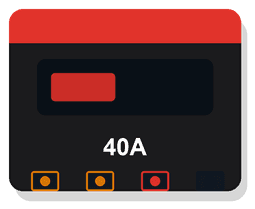
The Renogy Rover 40A is a practical MPPT controller for medium-size van and RV solar arrays. Its strongest points are a front display, 12V/24V support and a useful 100V PV input limit. Monitoring hardware is model- and bundle-dependent, and it offers less integrated system communication than a full Victron installation.
Verdict
Verified specifications
Renogy's current Rover 40A product page lists:
| Specification | Rover 40A |
|---|---|
| Rated charge current | 40A |
| Battery system | 12V / 24V |
| Maximum solar for 12V battery | 520W |
| Maximum solar for 24V battery | 1,040W |
| Maximum PV input voltage | 100V DC |
| Maximum terminal size | 8 AWG / 10mm² |
| Dimensions | 238 × 172 × 77mm |
| Weight | 2kg / 4.41lb |
Verify the current manual for battery presets, environmental limits, fusing and model-specific communication accessories.
What it does well
Useful panel-side voltage headroom
A 100V PV ceiling permits common series arrangements, but calculate worst-case cold open-circuit voltage rather than adding only the panel's warm-weather Vmp values.
Front-panel information
The LCD provides local system information without requiring a phone. That is helpful when troubleshooting at the vehicle or when another user does not have the app.
Appropriate size for many 400W arrays
The official 520W limit at 12V gives a typical 400W array useful headroom. Controller sizing must also check charge current and PV voltage; watts alone are insufficient.
Limitations
Monitoring is not necessarily included
Do not assume a listing includes the required Bluetooth or communication module. Compare the exact package contents and compatible Renogy app/module before purchase.
It is a standalone controller
Builders wanting shared battery-voltage/temperature sensing or a central display across several chargers should compare the communication architecture, not merely MPPT current.
Physical size and terminal limits matter
The Rover is larger than some 40A alternatives. If voltage-drop calculations call for cable larger than the terminal accepts, redesign the route and termination correctly rather than trimming conductor strands.
Rover 40A versus Victron SmartSolar
The Rover's front display and value can suit a straightforward single-controller build. Victron SmartSolar is often more attractive when Bluetooth is expected as standard, VE.Smart sensor sharing or VE.Direct monitoring is required, or the wider system already uses Victron equipment.
Neither brand is automatically correct. Compare:
- maximum cold-array Voc;
- permitted short-circuit current;
- maximum charge current;
- exact battery settings;
- temperature sensing;
- communications and history;
- enclosure/environment rating;
- cable and terminal requirements;
- warranty and service path.
Installation checks
- Calculate array cold open-circuit voltage below 100V with margin.
- Confirm expected charge current remains inside the 40A rating.
- Use the exact battery manufacturer's voltage and temperature instructions.
- Install controller-to-battery protection as Renogy specifies.
- Connect the battery side before PV when the manual requires that sequence.
- Verify polarity and torque before energizing.
- Commission in sunlight while observing PV voltage, charge current and battery behavior.
Bottom line
The Rover 40A is credible for a 12V van with roughly 400W of solar and for larger arrays within its published 24V limits. Its value depends on the complete monitoring bundle and whether the system needs deeper device integration.
Check the controller against your planned array
Use Roam Wired's free electrical design tool to calculate solar wattage and controller size before selecting a model.
Disclosure: This is an editorial assessment based on manufacturer documentation, not a claim of Roam Wired laboratory testing. Some links may earn an affiliate commission at no extra cost to you.
Frequently Asked Questions
Keep the build moving
Make the next build decision easier.
Get practical diagrams, calculator updates and honest product comparisons in your inbox.
Roam Wired
Roam Wired turns campervan research into practical plans. We publish transparent guidance, a free electrical design tool and marketplace resources for UK and US van builders.
About our approach