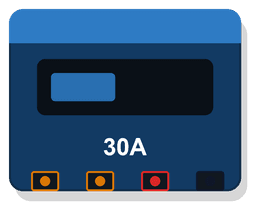
The MPPT charge controller sits between your solar panels and your house battery, extracting maximum power from the panels at every sun angle and temperature. Choosing the right one means picking the right amperage for your array and deciding how much you value Bluetooth monitoring and ecosystem integration.
For the full solar setup, see the solar setup guide. For panel recommendations: best solar panels for RV & van builds.
Size your charge controller automatically
Enter your panel wattage and battery voltage and we'll recommend the right controller — free.
MPPT vs PWM: choose MPPT
PWM controllers were the standard before MPPT became affordable. They work by rapidly connecting and disconnecting the panels to the battery, which effectively clamps panel voltage down to battery voltage — wasting any extra panel voltage as heat. On a warm, sunny day with a charged battery, a PWM controller can waste 20–30% of available solar.
MPPT controllers actively track the panel's maximum power point — the voltage/current combination that produces the most watts — and convert it down to the battery's charging voltage efficiently. An MPPT controller extracts 20–30% more power from the same panels, especially in partial sun, cold weather, and when the battery is significantly discharged.
MPPT costs a bit more (~$100–$160 for a good 30–40A unit vs. $20–$40 for a comparable PWM), but the extra solar harvest pays it back quickly. Buy MPPT.
Best MPPT charge controllers in 2026
Victron SmartSolar MPPT 100/30 — Best for most van builds
Price: ~$110–$130 | Max battery output: 30A | Max input voltage: 100V | Max panel input (at 12V): ~390W
The Victron SmartSolar 100/30 is the default choice for van builds with 200–400W of solar. It's small (fits in a tight cabinet), Bluetooth-connected (shows voltage, current, state of charge, and yield history in the VictronConnect app), and Victron's reliability is industry-leading.
The 100/30 handles two 175W panels in parallel easily (350W) and works with three panels if they're wired to keep Voc under 100V. It's also the right controller if you're building a full Victron ecosystem with a SmartShunt and Orion XS DC-DC charger — all three talk to each other through VictronConnect and Victron's networking protocol (VE.Smart Networking).
Best for: Most van builds with 200–400W of solar on a 12V system.
Victron SmartSolar MPPT 100/50 — Best for larger arrays
Price: ~$160–$180 | Max battery output: 50A | Max input voltage: 100V | Max panel input (at 12V): ~650W
Step up to the 100/50 if you're running 400W+ of solar. The higher amperage means more charge rate when the panels are producing at peak, and the extra headroom means you can add panels later without replacing the controller.
Best for: Larger builds with 400–600W+ solar, or builds that plan to expand.
Renogy Rover 40A — Best budget pick
Price: ~$90–$110 | Max battery output: 40A | Max input voltage: 100V
The Renogy Rover is the most popular budget MPPT controller. Solid performance, handles up to 40A output, and works with Renogy's own Bluetooth module (sold separately, ~$15) for app monitoring. No native Victron integration, but a capable standalone controller.
If you're not building a Victron ecosystem, the Renogy Rover 40A does everything you need at a lower price. Available on Amazon and at many RV stores.
Best for: Budget builds, non-Victron setups, or builds that just need a reliable controller without premium ecosystem features.
Renogy Rover 60A
Price: ~$130–$150 | Max battery output: 60A | Max input voltage: 100V
The 60A variant handles large arrays (up to ~780W at 12V). Useful for builds with 3–4 panels or plans for serious solar capacity.
Victron SmartSolar MPPT 150/35
Price: ~$220–$250 | Max battery output: 35A | Max input voltage: 150V
The 150V input rating lets you wire two 200W panels in series (combined Voc ~80V, safely under 150V). Series wiring gives better performance in partial shade conditions and at low light. This controller is the right choice if you're wiring panels in series rather than parallel.
See solar series vs parallel wiring for an RV.
Sizing your controller
Step 1 — Calculate required output amps: Controller amps = Total panel watts ÷ battery voltage Example: 400W panels ÷ 12V battery = 33.3A → choose a 40A controller (round up, never down)
Step 2 — Check max input voltage: Add up the open-circuit voltage (Voc) of your panel string (panels in series add Voc; panels in parallel don't). This must be below the controller's max input voltage (usually 100V or 150V).
Step 3 — Check max input watts: Your total array wattage should not exceed the controller's rated input. An oversized array will simply be clipped at the controller's max output.
| Array size | Battery | Recommended controller |
|---|---|---|
| Up to 200W | 12V | Victron SmartSolar 100/20 (~$80) |
| 200–400W | 12V | Victron SmartSolar 100/30 (~$120) |
| 400–600W | 12V | Victron SmartSolar 100/50 (~$170) |
| 600W+ | 12V | Victron SmartSolar 100/50 or 150/70 |
Wiring the controller
The MPPT controller connects between the panels and the battery:
- Solar input: MC4 connectors from your panel array
- Battery output: cable to your house battery or positive bus bar (fused within 12 inches of the battery)
- Remote temperature sensor (optional on some models): improves charging accuracy in hot or cold climates
Cable sizing for the battery output side: same as DC-DC charger wiring — 10 AWG for 30A, 8 AWG for 40–50A runs under 10 feet.
For the full wiring guide: how to wire a solar charge controller.
Related
Frequently Asked Questions
Keep the build moving
Make the next build decision easier.
Get practical diagrams, calculator updates and honest product comparisons in your inbox.
Roam Wired
Roam Wired turns campervan research into practical plans. We publish transparent guidance, a free electrical design tool and marketplace resources for UK and US van builders.
About our approach