Yes—a suitably sized portable power station can run an air conditioner. The harder question is whether it can start it safely and run it for long enough to be useful.
Three checks decide the answer
First, read the air conditioner's input label
BTU describes cooling capacity, not electrical consumption. Find the rated input watts or rated amps on the appliance label or manual. If only amps are shown, a rough single-phase estimate is:
Input watts ≈ volts × amps
Use the manufacturer's actual input specification wherever possible because compressor behavior and power factor make simple estimates imperfect.
Record four values:
- normal running watts;
- startup or locked-rotor requirement, if supplied;
- supply voltage and frequency;
- any recommended circuit or generator size.
Check 1: continuous inverter output
The power station's AC inverter must provide more than the air conditioner's highest sustained input, with capacity left for anything else plugged in. A station advertised as 2,000Wh may have a 1,800W, 2,000W or differently rated inverter; energy capacity and output power are separate specifications.
Avoid operating at the inverter limit for hours. High ambient temperature can reduce output or trigger thermal protection, especially when the power station is in a poorly ventilated van.
Check 2: compressor startup surge
Many compressor air conditioners draw a brief inrush current when starting. The power station must tolerate that event without its inverter shutting down. Do not assume a vague “surge watts” headline guarantees compatibility: manufacturers may define surge duration differently.
A soft-start device can reduce starting demand on compatible air conditioners, but it must be approved for the appliance and correctly installed. Variable-speed and purpose-built battery air conditioners often start more gently than older fixed-speed units.
Check 3: usable battery energy
Use this planning formula:
Runtime (hours) = battery capacity (Wh) × usable AC factor ÷ average AC input (W)
An initial usable AC factor of 0.85 allows for inverter losses and reserve. It is an estimate, not a guarantee.
Runtime examples
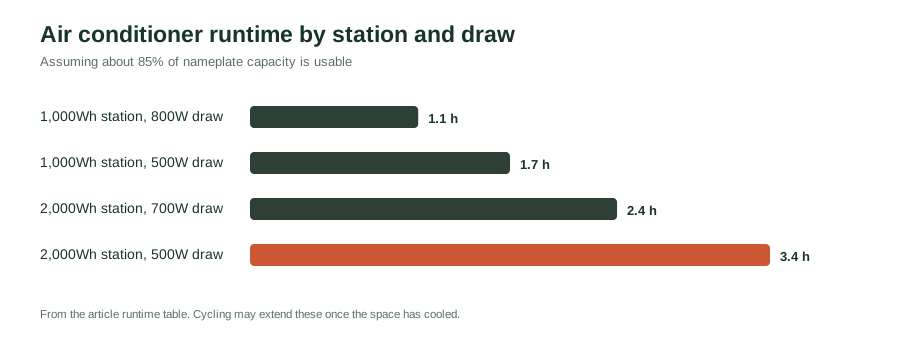
| Power station | Average AC input | Assumed usable AC energy | Estimated runtime |
|---|---|---|---|
| 1,000Wh | 500W | 850Wh | 1.7 hours |
| 1,000Wh | 800W | 850Wh | 1.1 hours |
| 2,000Wh | 500W | 1,700Wh | 3.4 hours |
| 2,000Wh | 700W | 1,700Wh | 2.4 hours |
| 3,600Wh | 700W | 3,060Wh | 4.4 hours |
These examples assume continuous average draw. A thermostat may reduce average energy once the interior reaches temperature, but direct sun, air leaks, poor insulation and extreme heat can keep the compressor running nearly continuously.
Measure for a better estimate
If the appliance and power station are compatible, use a suitable plug-in energy meter during a controlled test. Measure watt-hours over at least an hour in conditions similar to your trip. Then calculate:
Runtime = usable power-station Wh ÷ measured average watts
Do not leave a test unattended, block ventilation or use cords and adaptors that are not rated for the load.
Why portable air conditioners often disappoint in vans
Single-hose portable units exhaust hot air outside but also create negative pressure, drawing warm outside air back through gaps. Their duct must be short, sealed and routed so heat does not spill back into the van. A unit sitting inside with no effective exhaust will add heat overall.
Window units, split systems and purpose-built van air conditioners can be more effective arrangements, but mounting, drainage, weather sealing and electrical demand still need proper design.
Can solar extend the runtime?
Yes, but subtract real solar input from the average load—not the panel label.
Net battery draw = AC average watts + other loads − real charging watts
For example, an air conditioner averaging 700W while the station receives a real 450W from solar leaves about 250W plus losses coming from the battery. If cloud reduces solar to 100W, battery draw increases immediately.
Roof-mounted panels rarely produce nameplate power all day. Temperature, shadows, panel angle, controller limits and available roof area all matter. Use the power-station solar charging guide to model recharge separately.
Practical ways to improve cooling time
- Park in shade and use external window covers before the van heats up.
- Ventilate accumulated hot air before switching to active cooling.
- Insulate windows and seal obvious air leaks.
- Cool the smallest practical zone rather than the whole vehicle.
- Keep the power station and air conditioner intakes unobstructed.
- Pre-cool while connected to shore power where permitted.
- Use roof ventilation and fans when conditions do not require compressor cooling.
What size should you buy?
Start with the air conditioner, not the battery brand. Confirm its continuous and starting requirements, decide how many hours of cooling you genuinely need, then size the station with margin. Overnight compressor cooling often needs several kilowatt-hours; at that point, a permanently installed house battery, charging system and purpose-designed air conditioner may be more practical than a portable station.
Size the whole electrical system
The free Roam Wired design tool calculates batteries, charging and inverter requirements from your actual appliances instead of a one-product guess.
Frequently Asked Questions
Keep the build moving
Make the next build decision easier.
Get practical diagrams, calculator updates and honest product comparisons in your inbox.
Jack Kennedy is a self-builder who has built two vans. He created Roam Wired to simplify conversion planning and share free tools, supported by affiliate links.
About Jack