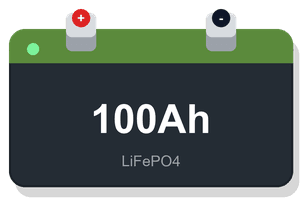
LiTime's base 12V 100Ah LiFePO4 battery is a budget-focused 1,280Wh option for moderate van and RV systems. The brand also sells several products with nearly identical names, which makes exact-model comparison more important than broad claims about “LiTime batteries.”
Verdict
Verified base-model specifications
LiTime's current 12V 100Ah product page lists:
| Specification | Base 12V 100Ah model |
|---|---|
| Nominal energy | 1,280Wh |
| Nominal capacity | 100Ah |
| Built-in BMS | 100A class |
| Cell description | Automotive-grade LiFePO4 cells |
Check the exact page and manual for dimensions, temperature protection, series/parallel limits and warranty attached to the SKU you are buying.
What it can realistically power
At nominal voltage, a 100A continuous BMS represents roughly 1,200–1,300W of DC power before voltage variation and system losses. Keep margin rather than designing continuously at the cutoff.
| Example load | Approximate battery effect |
|---|---|
| 12V compressor fridge | Often a few hundred Wh per day, depending on conditions |
| Laptop and device charging | Modest; easily within BMS current |
| 1,000W AC appliance | Roughly 90–100A DC after inverter losses |
| 2,000W AC appliance | Often more than 180A DC; unsuitable for one base 100A-BMS battery at full output |
Energy capacity and current capacity are separate. A short appliance session may use few watt-hours while still exceeding the BMS current limit.
What we like
- Low entry cost compared with many premium batteries.
- LiFePO4 chemistry provides useful cycle life and stable voltage when operated correctly.
- A 100Ah format fits many compact battery compartments.
- The published 100A BMS is adequate for common moderate-power loads.
What to verify before purchase
Exact version
LiTime offers base, Group 24, Bluetooth, heated and other application-specific batteries. Marketplace titles sometimes combine features from different versions. Match the model number, case, terminal layout and manual.
Low-temperature charging behavior
Do not charge LiFePO4 cells below the permitted cell temperature. If winter charging is expected, choose a model with explicit low-temperature charging protection or heating and confirm how it operates.
Warranty service
Read the written warranty for the exact seller and SKU. Check duration, exclusions, proof requirements, return shipping and whether the remedy is repair, replacement or pro-rated credit.
Charger compatibility
Verify the permitted bulk/absorption voltage, float behavior, maximum current and temperature-compensation setting. “Lithium mode” is not automatically correct for every battery.
LiTime versus a premium battery
A premium battery may justify its price through higher continuous current, integrated heating and monitoring, documented certifications, installer familiarity or a stronger service network. If the base LiTime already meets the electrical and environmental requirements, those extras may not be necessary.
Compare written specifications and after-sales process rather than assuming price alone proves cell quality.
Installation checklist
- Calculate daily watt-hours and peak DC current.
- Confirm the BMS supports inverter continuous and surge demand.
- Verify all charge settings against the exact manual.
- Size cable, fuse, switch and busbars for fault and operating current.
- Secure the battery against crash and vibration loads.
- Protect exposed terminals and preserve service access.
- Document the model, purchase date, manual and warranty.
Bottom line
The base LiTime 12V 100Ah battery can be good value for a modest van electrical system, but it should not inherit features from other LiTime variants in a review. Treat 1,280Wh and the 100A BMS as design inputs, then decide whether cold-weather controls, Bluetooth or higher current justify another model.
Check whether 100Ah and 100A are enough
Use the free Roam Wired electrical design tool to calculate daily energy and inverter current before choosing a battery.
Disclosure: This is an editorial assessment based on manufacturer documentation, not a claim of Roam Wired laboratory testing. Some links may earn Roam Wired an affiliate commission at no extra cost to you.
Frequently Asked Questions
Keep the build moving
Make the next build decision easier.
Get practical diagrams, calculator updates and honest product comparisons in your inbox.
Roam Wired
Roam Wired turns campervan research into practical plans. We publish transparent guidance, a free electrical design tool and marketplace resources for UK and US van builders.
About our approach