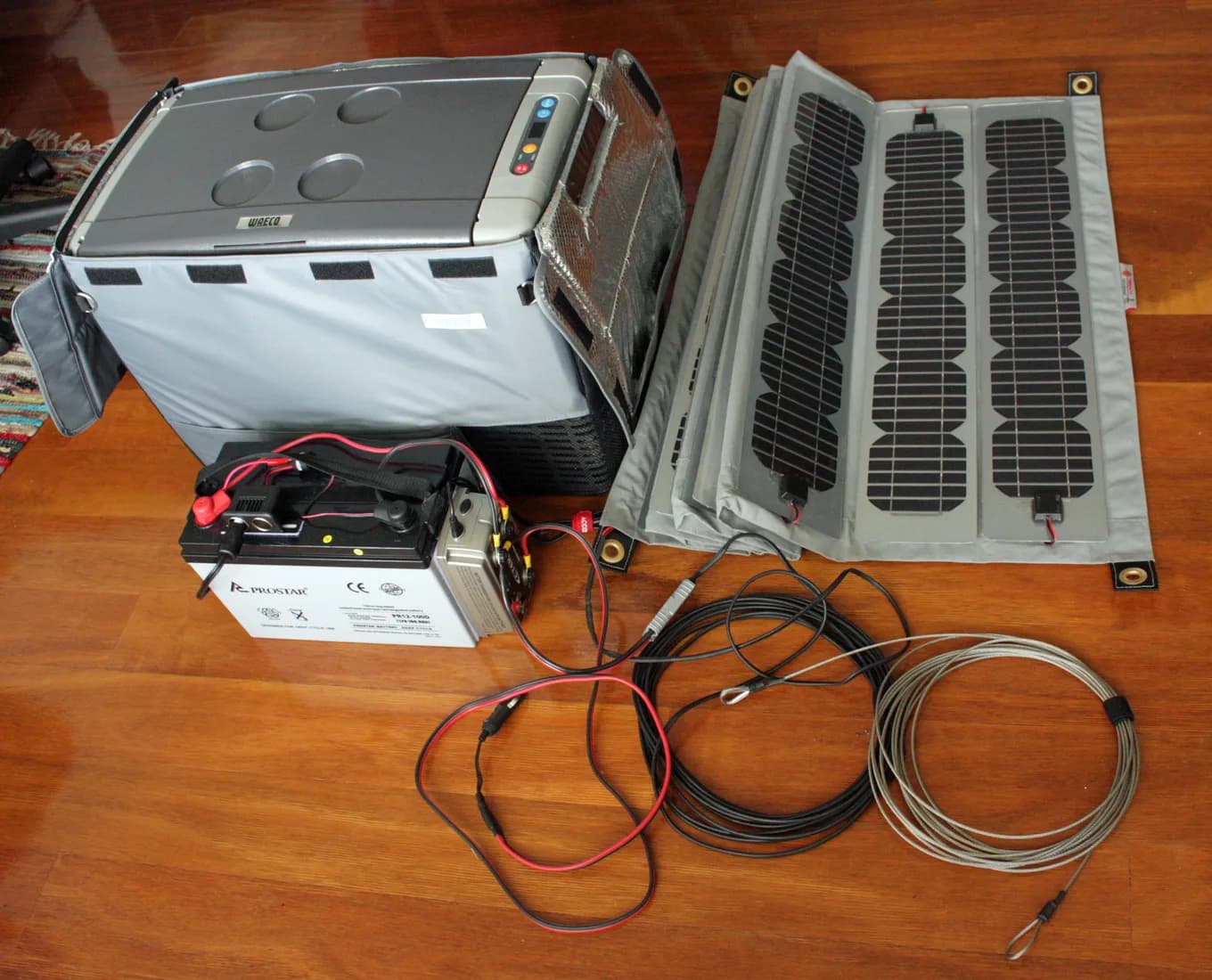
"How long will a power station run a 12V fridge?" is the first question almost every camper asks, and the honest answer is: longer than you'd think, because a fridge doesn't run constantly. This guide gives you a clear runtime table by capacity, the simple math so you can size for your own fridge, and the right power station for a weekend or a week off-grid.
This is well-researched guidance based on published fridge and power-station specifications and typical owner-reported consumption. Your real numbers shift with ambient temperature and use, so treat these as solid planning estimates, not guarantees.
The key idea: a fridge cycles on and off
A 12V compressor fridge might pull 40–60W while the compressor is actually running — but the compressor only runs part of the time to hold temperature. Over a full day it typically cycles for roughly 40–50% of the time, so the average draw is much lower: about 10–25W continuous, which works out to roughly 240–400Wh per day for most camping fridges.
That daily watt-hour figure is what actually determines runtime. Hot weather, a warm fridge you just loaded, and frequent lid-opening all push it toward the higher end.

Runtime table: days a power station runs a 12V fridge
The table below assumes about 90% of rated capacity is usable (after inverter and DC losses) and shows three daily-consumption scenarios: light (~240Wh/day, efficient fridge in mild weather), average (~360Wh/day), and heavy (~480Wh/day, hot weather or a larger fridge-freezer).
| Power station capacity | Light (~240Wh/day) | Average (~360Wh/day) | Heavy (~480Wh/day) |
|---|---|---|---|
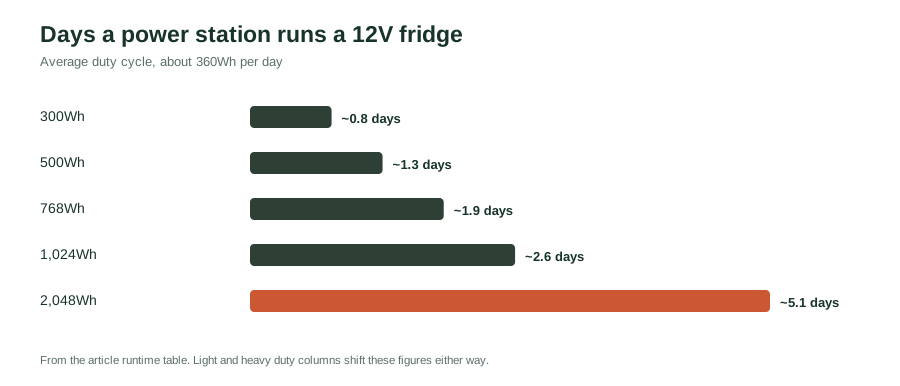
| 300Wh | ~1.1 days | ~0.8 days | ~0.6 days |
| 500Wh | ~1.9 days | ~1.3 days | ~0.9 days |
| 768Wh | ~2.9 days | ~1.9 days | ~1.4 days |
| 1,024Wh | ~3.8 days | ~2.6 days | ~1.9 days |
| 2,048Wh | ~7.7 days | ~5.1 days | ~3.8 days |
Read it as planning guidance: a 1,024Wh unit comfortably covers a long weekend with an average fridge; a 2,048Wh unit gets most people through a week.
Do the math for your fridge
You only need two numbers:
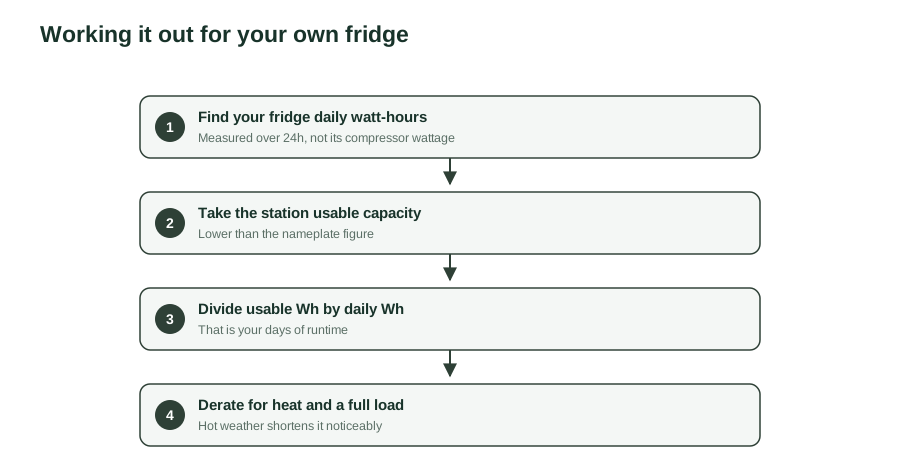
- Your fridge's daily use (Wh/day). Check the spec sheet, or estimate 240–400Wh for a typical 12V compressor fridge. For a precise figure, run the fridge off the power station for 24 hours and read how much charge it used.
- Your power station's usable capacity. Take the rated watt-hours and multiply by about 0.9.
Then: Runtime (days) = usable Wh ÷ daily Wh.
Example: a 1,024Wh power station (≈922Wh usable) running a fridge that uses 320Wh/day → 922 ÷ 320 ≈ 2.9 days.
Running more than a fridge?
Add your lights, devices, fan and CPAP to the fridge and our free calculator will size the whole system in watt-hours.
US equipment options
Still choosing the fridge?
Compare cabinet fit and storage needs first, then use documented daily energy or a clearly stated scenario in the runtime calculation. Do not assume two fridges consume the same energy because they use the same voltage.
Upright fridge
BODEGA CR65 65L RV Fridge and Freezer
Compare this upright fridge when planning the cabinet opening and food-storage space.
Check before choosing: Door clearance, ventilation, supply voltage and real daily energy in your expected conditions.
Upright fridge
BODEGA CR85X 83L RV Fridge and Freezer
A different-capacity upright option to compare before committing to the kitchen cabinetry.
Check before choosing: The exact outside dimensions and installation space; capacity alone does not establish fit or daily energy use.
These links open our US shop. Check the exact configuration, current price and availability there; affiliate products are purchased from the named supplier. We may earn a commission from qualifying purchases.
Three ways to run the fridge much longer
- Run the fridge on DC, not AC. Use the power station's 12V output rather than the 120V AC outlet so you skip the inverter conversion loss — that alone can add a fridge several extra hours of runtime.
- Add a solar panel. A 100–200W panel feeding the power station during daylight can offset most or all of a fridge's daily draw, turning a 2–3 day battery into effectively unlimited fridge runtime in good weather.
- Keep it cold and shaded. Pre-cool the fridge on shore power before you leave, keep it out of direct sun, and don't leave the lid open — ambient heat is the biggest driver of consumption.
Recommended power stations by trip length
Overnight to weekend: EcoFlow River 2 Pro (768Wh)
Light and fast-charging, the River 2 Pro covers a fridge for about two to three days at light-to-average draw — ideal for weekenders who also recharge from the car or sun.
Long weekend: EcoFlow Delta 2 (1,024Wh)
The Delta 2 runs an average fridge for roughly 2.5–3 days and has plenty of output for everything else at camp. It's expandable if your needs grow.
A week off-grid: Bluetti AC200L or Jackery Explorer 2000 Plus (~2,000Wh)
For a week with a fridge plus normal camp loads, a ~2,000Wh unit is the sweet spot. The Bluetti AC200L adds a 30A RV port; the Jackery Explorer 2000 Plus is expandable to very large capacities.
Verdict
A power station runs a 12V fridge for about a day per 350–400Wh of capacity at average draw — so 500Wh gets you overnight, 1,000Wh a long weekend, and 2,000Wh roughly a week, all extendable with a solar panel. Size from your fridge's real daily watt-hours, run it on DC where you can, and add sun for longer trips.
Stacking a fridge with other loads? Get an exact figure from our US power calculator, and if you're still choosing between a portable unit and a built-in system, read power station vs. house battery for van life.
FAQ
How long will a power station run a 12V fridge?
A typical 12V compressor fridge uses about 240–400Wh per day because the compressor cycles on and off rather than running constantly. So a 500Wh power station runs one for roughly a day, a 1,000Wh unit for about 2–3 days, and a 2,000Wh unit for about 5–7 days — before any solar or vehicle recharging.
How many watts does a 12V fridge use?
A 12V compressor fridge draws roughly 40–60W while the compressor is actively running, but it only runs part of the time. Averaged over 24 hours with the compressor cycling, real consumption is closer to 10–25W continuous, or about 240–400Wh per day depending on size, ambient temperature, and how often the lid is opened.
What size power station do I need to run a fridge for a weekend?
For a two-night weekend running just a 12V fridge, a 500–768Wh power station is usually enough. If you also charge phones, run lights, and want a margin for hot weather, step up to a 1,000Wh+ unit, or plan to recharge from solar or your vehicle during the day.
Related
Narrow the US shortlist
Compare the exact equipment.
Frequently Asked Questions
Keep the build moving
Make the next build decision easier.
Get practical diagrams, calculator updates and honest product comparisons in your inbox.
Jack Kennedy is a self-builder who has built two vans. He created Roam Wired to simplify conversion planning and share free tools, supported by affiliate links.
About Jack