Select a generator by continuous output, startup demand and the equipment it will supply, then follow the generator's outdoor-use and exhaust instructions.
A generator is the last resort for most van lifers — noisy, requires fuel, and many campsites prohibit them. But for winter off-grid use, extended remote stays, or running an air conditioner, they're genuinely useful. When you need one, here are the best options.
For an overview of all charging methods: RV charging options compared and what size generator for an RV?.
Inverter generators only for van use
Always buy an inverter generator for van or RV charging use. Conventional generators produce power with significant harmonic distortion that can damage sensitive electronics (converter/chargers, laptops, CPAP machines). Inverter generators produce stable, clean AC power safe for all equipment — and they're significantly quieter.
Best generators for van and RV use
Honda EU2200i — Best overall
Price: ~$1,100 | Output: 2,200W peak, 1,800W continuous | Noise: 48–57 dB | Weight: 47 lbs | Runtime: 8.1 hours at 25% load
The Honda EU2200i is the gold standard for portable inverter generators. Extremely quiet (whisper mode at ~48 dB — conversation level), reliable, fuel-efficient, and Honda's reputation for longevity is unmatched. The parallel capability lets you link two EU2200i units for up to 4,400W if needed.
The downside: $1,100 is a lot if you only use a generator a few times a year. But van lifers who depend on a generator in winter consistently choose Honda for the reliability.
Best for: Full-timers who need a generator regularly; anyone in cold/cloudy regions where solar isn't enough.
Yamaha EF2200iS
Price: ~$1,050 | Output: 2,200W peak, 1,800W continuous | Noise: 51.5–61 dB | Weight: 55 lbs
The Honda's direct competitor — similar specs, similar price. The Honda runs quieter and is lighter; the Yamaha has slightly easier access to the oil fill. Either is excellent. If your area has better Yamaha dealer support than Honda, that's a tie-breaker.
WEN 56200i — Best budget inverter generator
Price: ~$350 | Output: 2,000W peak, 1,600W continuous | Noise: 51 dB | Weight: 48 lbs
The WEN 56200i is a capable budget inverter generator at roughly 1/3 the price of a Honda. Clean power output, reasonable noise level, and enough output to run a converter/charger for battery charging. Reliability and longevity aren't in Honda's league, but for occasional use it's a legitimate option.
Best for: Budget-conscious van lifers who want a generator for backup use only.
Champion 2500W Dual Fuel Inverter
Price: ~$500 | Output: 2,500W peak, 2,000W continuous | Fuel: Gas or propane | Weight: 53 lbs
The dual-fuel capability is useful if you already carry propane for cooking — you can run the generator off your propane supply. The 2,500W peak handles most converter/charger + some appliance loads simultaneously. Not as refined as Honda but solid for the price.
EcoFlow Smart Generator (Dual Fuel)
Price: ~$500 | Output: 1,800W | Fuel: Gas or LPG
EcoFlow's generator is designed to integrate directly with their portable power stations, auto-starting when the station reaches a low battery level. If you're in the EcoFlow ecosystem (Delta Pro, Delta Pro Ultra), this integration is genuinely useful.
Generator safety: always use outdoors
Never run a generator inside a vehicle or enclosed space
Generators produce carbon monoxide — an odorless, colorless, lethal gas. Always run generators outside, downwind, at least 20 feet from the van. Never leave a generator running in a garage with the door open, next to a door or window, or under an awning. CO poisoning kills people every year in camping scenarios.
Worked planning check
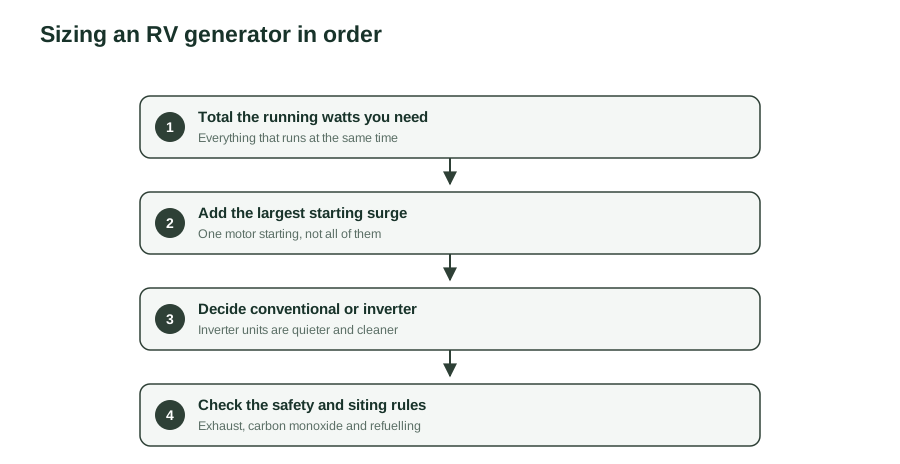
A 1,200W charger and 600W appliance operating together require 1,800W running output before startup margin. A generator advertised by a 2,000W peak figure may have a lower continuous rating. Never operate a generator inside the van, garage, awning or another enclosed space.
The figures or dimensions in this example are explicit planning assumptions, not a product test or an installation specification. Replace them with your equipment data and actual measurements.
Planning questions
Is generator peak power its usable continuous output?
No. Check the rated continuous output, starting-load allowance and any temperature or altitude derating before adding loads.
Can I use a generator under an awning?
Follow the manufacturer’s outdoor placement and exhaust-clearance instructions. Never run it in a van or enclosed space, and prevent exhaust entering occupied spaces.
Can a generator charge the house battery directly?
Use a compatible charging arrangement specified for the generator and battery system. A mains charger’s actual input and grounding requirements must be checked, not just its battery-side current.
Related
Use the free electrical planner to organise your daily loads and charging assumptions.
Continue planning
Frequently Asked Questions
Keep the build moving
Make the next build decision easier.
Get practical diagrams, calculator updates and honest product comparisons in your inbox.
Jack Kennedy is a self-builder who has built two vans. He created Roam Wired to simplify conversion planning and share free tools, supported by affiliate links.
About Jack