Where and how you mount your LiFePO4 battery matters for safety, cable management, and build quality. LiFePO4 has different requirements from AGM — notably, no off-gassing, which changes ventilation requirements significantly.
If you'd rather not work out cable sizes and fuse ratings by hand, our free electrical calculator sizes the cables and fuses for your system and draws the wiring diagram.
Does LiFePO4 need a vented battery box?
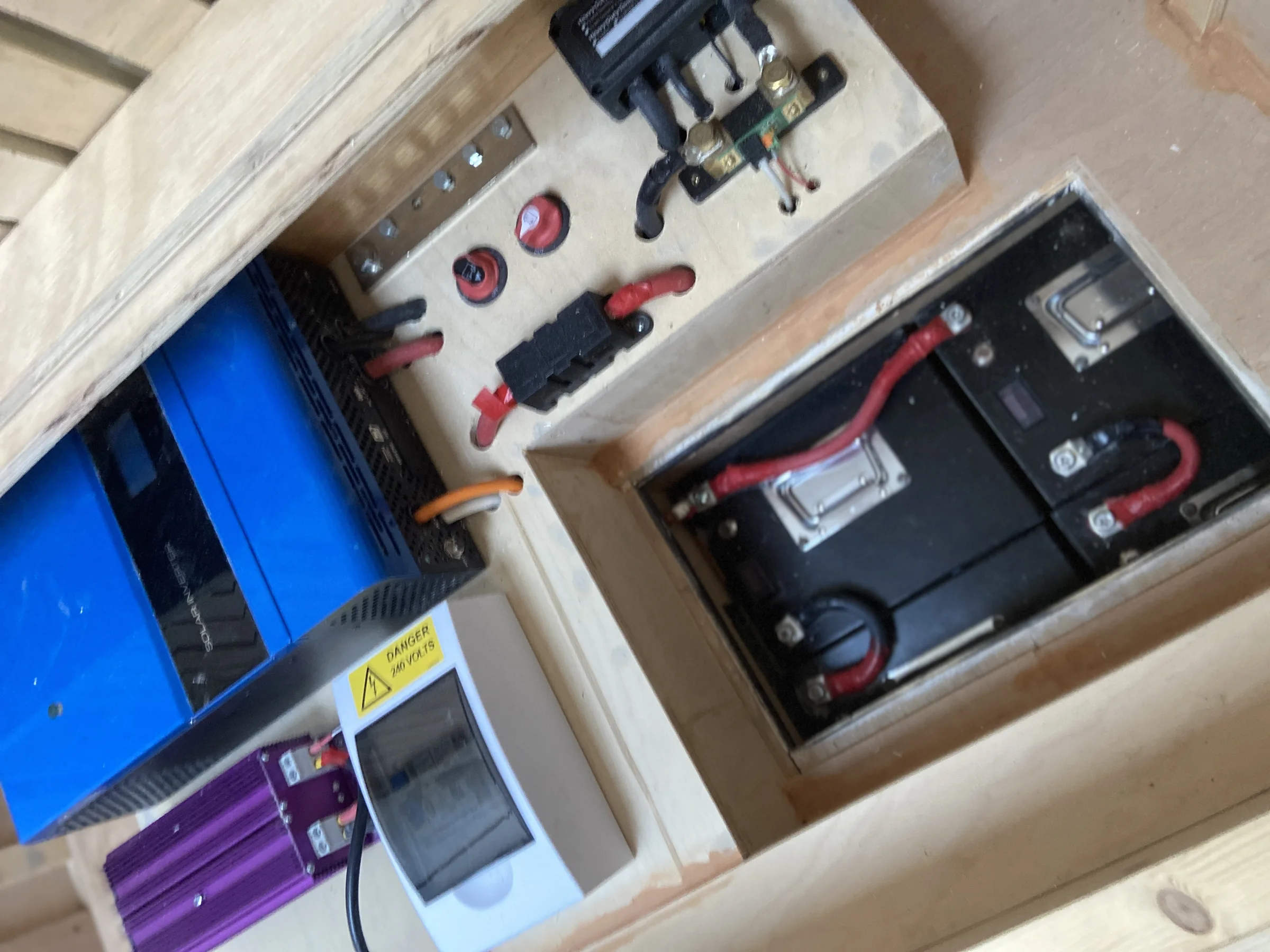
Unlike flooded lead-acid batteries (which release hydrogen during charging), LiFePO4 does not produce gas under normal conditions. You do not need a vented battery box for LiFePO4.
A sealed compartment is fine. This is one of the advantages of LiFePO4 over traditional lead-acid — you can mount it inside the living space of the van without ventilation concerns.
AGM batteries also do not normally gas (they are sealed), but under overcharge or failure they can vent small amounts of gas. A vented compartment is still recommended for AGM.
Mounting location options
Under the bed platform
The most common location in van conversions. Advantages:
- Close to the main 12V distribution
- Low centre of gravity
- Good access via a removable panel or drawer
Build a wooden box or frame that holds the battery securely. The battery must not be able to slide during driving. Line the bottom with anti-slip matting or secure with L-brackets.
Under the driver's/passenger seat
Many factory vans have a step or flat area under seats that fits a compact leisure battery (100Ah units typically 260 × 170 × 220mm). This minimises cable runs to the alternator charging circuit.
In the engine bay (charging battery only)
If you have a separate starter battery and leisure battery, the leisure battery can go in a purpose-built location within the van — the engine bay is not recommended for LiFePO4 due to heat.
Rear floor below floor level
Some builds use a cut-out in the floor to create a low-profile battery bay. This is structurally demanding and not recommended for beginners.
Ready-made battery enclosures
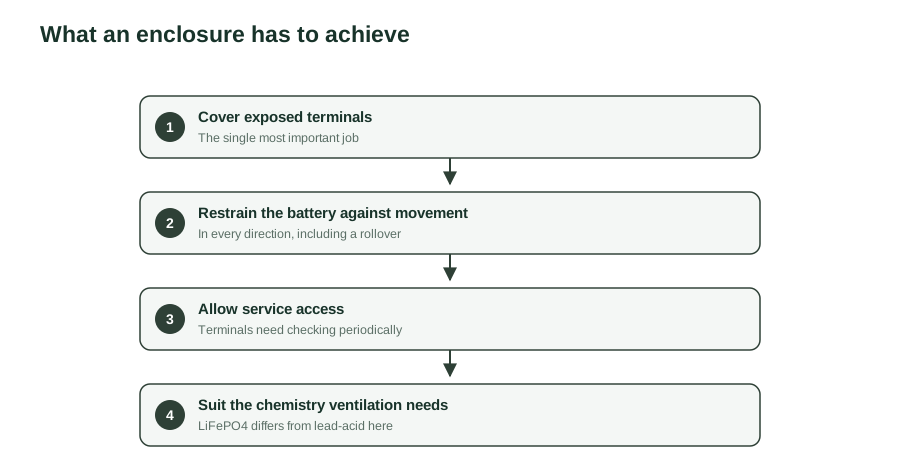
Several ready-made enclosures are available for common battery sizes:
Victron LiFePO4 batteries are self-contained and do not require a separate enclosure — they come in their own cases.
Group 31 / 100Ah prismatic battery boxes: Plastic battery boxes (designed for car audio or marine use) work well for individual LiFePO4 batteries. Available from motor factors and online retailers.
Aluminium battery boxes: More robust than plastic. Available from campervan equipment suppliers.
DIY plywood box: For prismatic cells in a DIY LiFePO4 build, a plywood box compresses the cells (important for longevity of prismatic cells) and houses the BMS.
DIY battery box build (for prismatic cells)
For DIY builds using EVE or CATL prismatic cells:
- Measure your cell stack — four 280Ah cells side by side. Typical dimensions: 175 × 72 × 207mm per cell.
- Build from 18mm birch ply — sides, base, and lid. Internal dimensions to match cell stack plus 5mm clearance.
- Add compression: Prismatic cells should be compressed at approximately 10–12 psi. Use threaded rod through the box sides with nuts and plates to apply even pressure.
- BMS mounting: Attach the BMS inside the box lid or to the side wall. Ensure BMS ventilation is not obstructed.
- Terminal cutouts: Small cutout for positive/negative cables and balance wire loom to the BMS.
- Secure in van: Fix the box to the floor or bed frame with L-brackets and M8 bolts.
Securing the battery for road safety
A leisure battery in a moving vehicle is a heavy object (12–30kg). An unsecured battery sliding or falling during an emergency stop or accident can:
- Cause a short circuit (if terminals contact metal)
- Cause injury
- Damage surrounding equipment
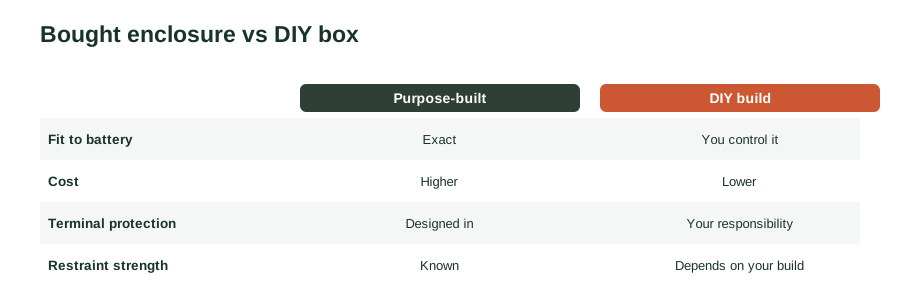
Minimum security: The battery must not be able to move in any direction. Use a purpose-made battery holder, L-brackets fixed to the floor and side walls, or a purpose-built battery box that is itself bolted down.
Battery terminal covers are good practice — prevent accidental contact with the terminals if any metal object falls into the battery bay.
FAQ
Can I mount a LiFePO4 battery on its side?
Most prismatic LiFePO4 batteries can be mounted in any orientation — check the manufacturer's datasheet. Cylindrical cells (rare in campervans) should be mounted per manufacturer instructions. Most 12V LiFePO4 battery cases are designed for horizontal (flat) mounting but work safely on their side.
Does my battery box need to be fireproof?
No — LiFePO4 chemistry is significantly more thermally stable than other lithium chemistries (e.g., NMC). LiFePO4 does not readily enter thermal runaway. A normal plywood or plastic enclosure is appropriate.
How far from my battery can my inverter be?
The DC cables between your battery (or bus bar) and inverter should be as short as possible — ideally under 1.5m. Beyond 1.5m, voltage drop under high current becomes significant. Factor battery location into your inverter placement.
Related
Keep the build moving
Make the next build decision easier.
Get practical diagrams, calculator updates and honest product comparisons in your inbox.
Jack Kennedy is a self-builder who has built two vans. He created Roam Wired to simplify conversion planning and share free tools, supported by affiliate links.
About Jack