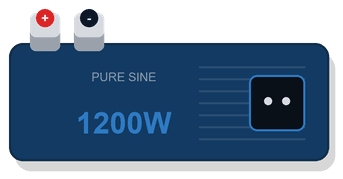
The Victron Phoenix is frequently recommended for UK campervan builds. But is it the right choice for your van? This editorial review compares the current range using published specifications, installation requirements and system suitability; it does not claim long-term laboratory testing by Roam Wired.
If you are still deciding what size inverter you need, start with our guide to choosing the best inverter for a van conversion. If you are unsure whether you even need a pure sine wave inverter, read our pure sine wave vs modified sine wave comparison first.
Size Your Inverter Properly
Our free calculator analyses your appliance list and recommends the right inverter size for your campervan build. Takes two minutes.
The Phoenix Range: Which Models Exist?
Victron makes the Phoenix inverter in several sizes. The three most relevant for campervan builds are:
| Model | Continuous Output | Peak Output | UK Price (Approx.) | Weight |
|---|---|---|---|---|
| Phoenix 12/500 (230V) | 400W | 900W | £160-£190 | 3.0 kg |
| Phoenix 12/800 (230V) | 650W | 1,500W | £220-£260 | 4.4 kg |
| Phoenix 12/1200 (230V) | 1,000W | 2,200W | £300-£350 | 6.0 kg |
All three are available in 12V and 24V versions. For the vast majority of UK campervans running 12V systems, you want the 12V variant with 230V AC output.
There is also a Phoenix 12/250 for very small loads, and larger models (1600VA, 2000VA, 3000VA, 5000VA) for bigger installations, but these are less common in standard van conversions.
VA vs Watts — What Is the Difference?
Victron rates the Phoenix in VA (volt-amps). Watts and VA are equal only at a power factor of one; motors, transformers and many electronic loads can draw more VA than their stated watts. Use the exact model's published continuous-watt and peak-power ratings instead of converting the VA number by assumption.
Build Quality and Design
The Phoenix is built in a compact aluminium case that acts as a heatsink. It feels solid and heavy for its size — this is not a cheap inverter in a plastic shell. The case is well-finished with no sharp edges, and the mounting tabs are robust enough to handle years of vibration.
Physical Layout
- DC input: Two bolt terminals (M8 on the 800 and 1200, M6 on the 500) for battery cables
- AC output: Standard IEC C13 socket on the 500 and 800, hardwire terminal block on the 1200
- Control port: VE.Direct digital port for monitoring and remote on/off
- Switch: Physical on/off rocker switch on the unit itself
- Ventilation: Internal fan that runs on demand (not constantly)
The dimensions are compact enough to mount under a seat, inside a furniture carcass, or in a dedicated electrical bay. The 800VA model measures roughly 260 x 125 x 65mm — about the size of a large paperback book.
Performance: How Does It Actually Perform?
Pure Sine Wave Output
The Phoenix produces a true pure sine wave output, meaning it will run any appliance that works on household mains power. This includes sensitive electronics (laptops, phone chargers, CPAP machines), appliances with motors (fans, blenders), and anything with a transformer.
A modified sine wave inverter can damage or fail to run these devices. The Phoenix eliminates that concern entirely.
Efficiency
Victron publishes efficiency figures of 89-93% depending on the model and load. In practice, at moderate loads (40-70% of rated capacity), expect around 90% efficiency. This means for every 100W you draw from the AC side, about 110W comes from your battery.
At very light loads (under 10% of capacity), efficiency drops because the inverter's own overhead becomes a larger proportion of total draw. This is where oversizing your inverter works against you — a 1200VA inverter running a 30W laptop charger is less efficient than an 800VA doing the same job.
Standby Drain
One area where the Phoenix is not class-leading is standby power consumption. With no load connected but the inverter switched on:
| Model | Standby Drain (No Load) |
|---|---|
| Phoenix 12/500 | ~8W (0.67A at 12V) |
| Phoenix 12/800 | ~10W (0.83A at 12V) |
| Phoenix 12/1200 | ~12W (1.0A at 12V) |
Over 24 hours, that 10W standby drain on the 800VA model costs you 240Wh — a meaningful chunk of a 100Ah battery. This is why you should always switch the inverter off when you are not using it. See our inverter standby drain guide for strategies to minimise this waste.
ECO Mode
The Phoenix includes an ECO mode that puts the inverter into a low-power sleep state when no load is detected. It periodically pulses the output to check for a load, and if it detects one, it wakes up fully. In ECO mode, standby consumption drops to roughly 2-3W.
The catch: ECO mode does not always detect very light loads (under about 15-25W depending on the model). A phone charger drawing 10W might not trigger the wake-up. It works best when you have an appliance that draws a clear load — a laptop, a fridge, or a charger pulling more than 20W.
ECO Mode and Light Loads
ECO mode can fail to detect loads below about 15-20W. If you rely on it for phone charging overnight, you may find the inverter does not wake up. Test with your specific chargers before depending on it. For critical overnight loads like a CPAP machine, disable ECO mode and accept the standby drain.
VE.Direct Monitoring
Every Phoenix inverter has a VE.Direct port — Victron's proprietary digital communication interface. This enables:
- Victron Connect app monitoring via a VE.Direct Bluetooth dongle (
£35) or VE.Direct USB cable (£25). You can see output watts, input voltage, temperature, and error codes on your phone. - Integration with a Victron GX device (Cerbo GX, Venus GX) for central system monitoring via the VRM portal. If you already have a Victron ecosystem (SmartSolar MPPT, SmartShunt, etc.), the Phoenix slots right in.
- Remote on/off via a VE.Direct non-inverting cable or through the GX device.
If you are already invested in the Victron ecosystem — and many UK van builders are — this integration is a significant advantage over competitors.
Mounting and Installation
The Phoenix mounts via four bolt holes (two on each side). It should be installed:
- In a well-ventilated space (allow at least 50mm clearance on all sides)
- Away from water sources and direct sunlight
- Vertically or horizontally — both are fine
- Close to the battery bank to keep DC cable runs short (reduces voltage drop and improves efficiency)
- On a non-combustible surface
DC cable sizing is critical. For the 800VA model at full load, the DC draw is approximately 75A. You need 25mm² cable for runs up to 1.5m and 35mm² for longer runs. Always fuse the positive cable within 300mm of the battery.
Pros and Cons
What We Like
- Build quality is excellent. The aluminium case is solid, the terminals are properly sized, and it feels like professional equipment.
- Pure sine wave output is clean and reliable. No complaints running laptops, phone chargers, or sensitive medical devices.
- VE.Direct integration makes it a natural fit for Victron-based systems, which are increasingly the standard in UK van builds.
- Wide input voltage range (10.5V-15.5V for 12V models) means it keeps working as battery voltage drops, shutting down gracefully at low voltage rather than cutting out abruptly.
- Five-year warranty — better than most competitors in the price range.
- UK support through Victron's dealer network is good, with stock readily available from UK distributors.
What We Do Not Like
- Standby drain is higher than some competitors. The Renogy 1000W inverter, for example, claims about 6W standby compared to the Phoenix 800's 10W.
- ECO mode is unreliable for light loads. It works in theory but fails to detect chargers under 15-20W, limiting its usefulness.
- IEC C13 outlet on the 500 and 800 models means you need an IEC-to-BS1363 adapter cable or must hardwire to your 230V sockets. This is a minor annoyance but worth noting — a standard UK plug socket on the inverter itself would be more convenient.
- No built-in transfer switch. If you also have shore power, you need a separate changeover switch or automatic transfer relay. The Victron MultiPlus range includes this, but at significantly higher cost.
- Price. The Phoenix costs £50-£100 more than comparable inverters from Renogy, Giandel, or EDECOA. You are paying for the Victron name, build quality, and ecosystem — but it is a real price premium.
How Does It Compare to Alternatives?
| Feature | Victron Phoenix 12/800 | Renogy 1000W | EDECOA 1000W |
|---|---|---|---|
| Continuous Output | 650W | 1,000W | 1,000W |
| Price | ~£240 | ~£140 | ~£100 |
| Wave Type | Pure sine | Pure sine | Pure sine |
| Standby Drain | ~10W | ~6W | ~8W |
| Warranty | 5 years | 2 years | 1 year |
| Monitoring | VE.Direct | None | None |
| Build Quality | Excellent | Good | Adequate |
| UK Support | Excellent | Limited | Limited |
The Renogy and EDECOA offer more watts per pound. If budget is your primary constraint and you do not need Victron ecosystem integration, they are legitimate alternatives. But if you want the confidence of Victron's build quality, monitoring, and warranty, the Phoenix justifies its premium for many builders.
For a broader comparison, see our best inverter for van conversions guide.
Which Phoenix Model Should You Choose?
- Phoenix 12/500 (400W continuous): Suitable if you only run laptops, phone chargers, and light loads. Not enough for a kettle, hair dryer, or any heating appliance.
- Phoenix 12/800 (650W continuous): The most popular choice for campervans. Handles laptops, chargers, a small TV, a CPAP machine, and most moderate loads. Will not run a kettle or hair dryer.
- Phoenix 12/1200 (1000W continuous): Choose this if you want to run a low-wattage kettle (1000W), a NutriBullet-style blender, or similar mid-power appliances. Still will not handle a full-power hair dryer or domestic kettle.
For most UK van conversions, the Phoenix 12/800 hits the sweet spot of price, size, and capability.
FAQ
Is the Victron Phoenix worth the extra money over cheaper inverters?
If you are building a Victron-based system with SmartSolar, SmartShunt, and potentially a Cerbo GX, then yes — the VE.Direct integration and consistent ecosystem is worth the premium. If you have no other Victron components and just need a reliable inverter, a Renogy pure sine wave inverter at £140 does the job well and saves you £100.
Can the Phoenix 12/800 run a coffee machine?
It depends on the machine. A Nespresso capsule machine draws around 1,200W during heating, which exceeds the 800's 650W continuous rating. The 1,200VA model (1,000W continuous) could handle some lower-power machines, but most espresso machines need a 1,500W+ inverter. See our coffee machine power guide for details.
Does the Phoenix need a fuse?
Yes. The DC positive cable between the battery and inverter must be fused. Use a fuse rated for the cable size and inverter maximum draw — typically a 100A ANL or MEGA fuse for the 800VA model. Mount it within 300mm of the battery positive terminal.
Can I use the Phoenix with lithium (LiFePO4) batteries?
Absolutely. The Phoenix works perfectly with LiFePO4 batteries. Its low-voltage disconnect is set at 10.5V by default, which is appropriate for lithium. You can adjust this via VE.Direct if your BMS has a different cutoff point.
Related
Keep the build moving
Make the next build decision easier.
Get practical diagrams, calculator updates and honest product comparisons in your inbox.
Roam Wired
Roam Wired turns campervan research into practical plans. We publish transparent guidance, a free electrical design tool and marketplace resources for UK and US van builders.
About our approach