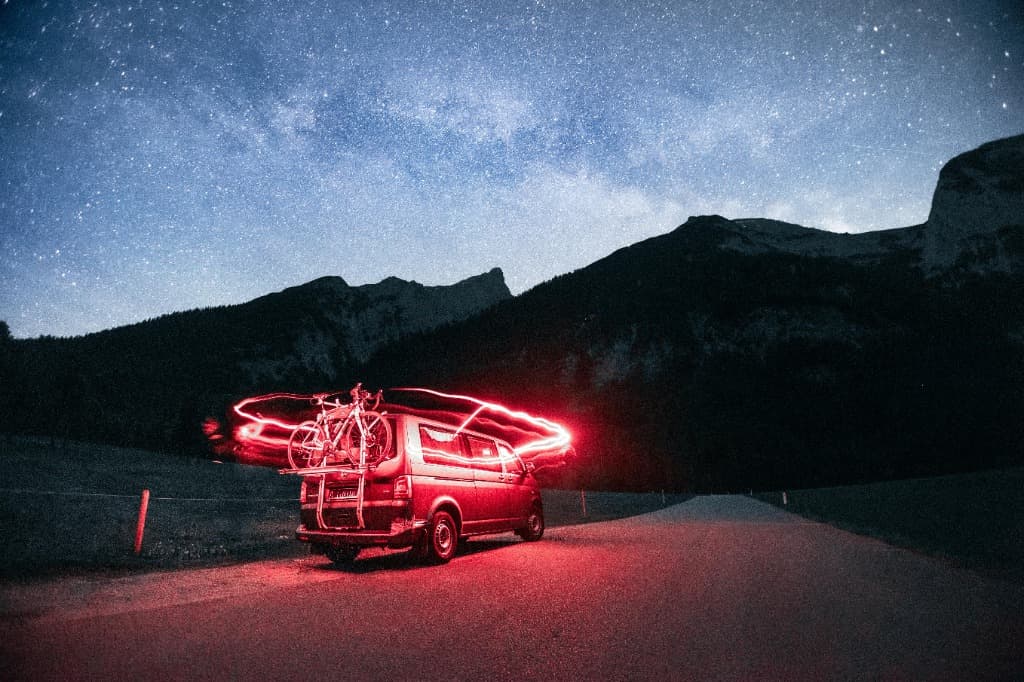
There is a particular kind of freedom that comes with knowing your van can park anywhere and keep the lights on, the fridge cold, and your phone charged — without ever plugging into a campsite bollard. Going fully off-grid is the dream for many van lifers, and a well-designed electrical system is what makes it possible.
This guide sits within our complete campervan electrical system resource, which covers every component in detail. Here, we focus specifically on designing a system that eliminates your dependence on hook-up. If you want to jump straight to sizing, our calculator will build a custom off-grid system based on your exact appliance list.
Design Your Off-Grid System
Tell us what appliances you want to run off-grid, and our calculator sizes your batteries, solar, and charging — with a custom wiring diagram included.
What Does "Off-Grid" Actually Mean for a Campervan?
In practical terms, an off-grid campervan electrical system is one that can sustain your daily energy needs indefinitely without connecting to mains electricity. That means your charging sources — primarily solar and alternator — must put back at least as much energy as you use each day.
This is straightforward in a British summer. It is considerably harder in a UK winter, when solar output drops to roughly 15-20% of peak values. True year-round off-grid capability requires careful planning and, in most cases, some compromises.
The three pillars of an off-grid system are:
- Sufficient battery capacity to store enough energy for at least 2-3 days without meaningful charging
- Adequate solar generation to replenish your batteries during daylight hours
- Alternator charging as a reliable secondary source when driving
Get these three right and you will rarely, if ever, need a hook-up post. How far you need to take this depends on your lifestyle — weekenders and part-time versus full-time van-dwellers have very different requirements.
Step 1: Know Your Daily Energy Budget
Everything starts with understanding how much power you actually use. Without this number, you are guessing — and guessing almost always leads to either an oversized system that costs too much or an undersized one that leaves you in the dark.
A typical off-grid van build in the UK runs somewhere between 1,000 Wh and 2,500 Wh per day, depending on whether you work from the van, heat with a diesel heater, and what kind of fridge you use. Our power audit guide walks through the process step by step.
Here is a realistic daily budget for a well-equipped off-grid van:
| Appliance | Watts | Hours/Day | Daily Wh |
|---|---|---|---|
| LED Lighting | 12W | 5h | 60 |
| Compressor Fridge | 45W | 12h | 540 |
| Diesel Heater Fan | 25W | 8h | 200 |
| Phones x2 | 15W | 3h | 90 |
| Laptop | 60W | 4h | 240 |
| Water Pump | 60W | 0.5h | 30 |
| Roof Vent | 18W | 3h | 54 |
| Router/Starlink | 50W | 8h | 400 |
| Total | 1,614 Wh |
If you are running a Starlink dish, that alone can account for 25% of your daily consumption. It is the single biggest consideration for off-grid vanlifers who need internet connectivity.
Use the calculator for accuracy
The table above is a rough guide. Your actual consumption depends on your specific appliances, usage patterns, and whether you run anything through an inverter (which adds ~15% loss). Our calculator handles all of this automatically.
Step 2: Size Your Battery Bank
For off-grid use, your battery bank needs to store enough energy to cover at least two full days of consumption without any charging input. This buffer accounts for consecutive overcast days, which are common in the UK from October through March.
Using the 1,614 Wh daily budget above:
- Minimum capacity: 1,614 Wh x 2 days = 3,228 Wh
- With LiFePO4 batteries (80% usable): 3,228 / 0.8 = 4,035 Wh, or roughly 335 Ah at 12V
- With AGM batteries (50% usable): 3,228 / 0.5 = 6,456 Wh, or roughly 538 Ah at 12V
This is why lithium batteries dominate serious off-grid builds. You need almost 60% less physical battery capacity to achieve the same usable storage compared with AGM. For a deeper comparison, see our LiFePO4 vs AGM guide.
For the system above, a practical configuration would be:
- Budget off-grid: 2 x 200Ah LiFePO4 (400Ah / 4,800 Wh usable) — comfortable buffer
- Mid-range off-grid: 300Ah LiFePO4 (3,600 Wh usable) — adequate for most conditions
- Minimum viable: 200Ah LiFePO4 (2,400 Wh usable) — tight, requires disciplined usage
AGM is not ideal for off-grid
While you can build an off-grid system with AGM batteries, the weight, volume, and cycle life limitations make it impractical for serious off-grid use. A 400Ah AGM bank weighs roughly 120kg versus about 50kg for the same usable capacity in lithium.
Step 3: Design Your Solar Array
Solar is the backbone of any off-grid campervan system. The key question is not how much power your panels produce in June — it is how much they produce in December.
For a detailed dive into solar sizing, including seasonal yield data for the UK, see our campervan solar setup guide and our solar sizing guide.
UK Solar Yields by Season
Here is what you can realistically expect from a south-facing roof-mounted system in southern England:
| Season | Peak Sun Hours | 400W System Daily Yield |
|---|---|---|
| Summer (Jun-Aug) | 4.5-5.2h | 1,300-1,520 Wh |
| Spring/Autumn | 2.3-3.5h | 670-1,020 Wh |
| Winter (Nov-Jan) | 0.8-1.2h | 230-350 Wh |
The winter figures are sobering. A 400W system in December might only produce 250 Wh per day — less than 16% of the 1,614 Wh budget above. This is why alternator charging is not optional for UK off-grid builds.
How Much Solar Do You Need?
For summer-only off-grid use, 300-400W of solar is usually sufficient for a moderate build. For year-round capability:
- 400W minimum — covers moderate use in spring through autumn
- 600W+ recommended — provides meaningful winter contribution and faster summer charging
- Roof space is the practical limit — most medium vans (Transit, Sprinter) can fit 400-600W of rigid panels
For a deep dive into winter solar performance, see our winter solar guide.
Step 4: Set Up Alternator Charging
If solar is the backbone, alternator charging via a DC-DC charger is the safety net. When you drive, your engine alternator can push 20-50A into your leisure batteries, which translates to roughly 250-600W of consistent charging.
A 30-minute drive with a 30A DC-DC charger puts approximately 180 Wh into your batteries. A 2-hour drive adds around 720 Wh — nearly half a day's consumption for many setups.
For UK off-grid builds, we strongly recommend a DC-DC charger over a traditional split-charge relay. The reasons are detailed in our DC-DC vs split-charge relay comparison, but the short version is: modern vehicles with smart alternators require a DC-DC charger, and even on older vehicles, a DC-DC charger delivers faster, more complete charges.
Recommended DC-DC Charger Sizes
| Daily Consumption | Minimum DC-DC Size | Recommended |
|---|---|---|
| Under 1,000 Wh | 20A | 30A |
| 1,000-2,000 Wh | 30A | 40-50A |
| Over 2,000 Wh | 40A | 50A+ or dual units |
Driving charges faster than you think
A 50A DC-DC charger running for 2 hours delivers 1,200 Wh — that is enough to fully replenish a moderate day's consumption. If you drive regularly, even short distances, alternator charging can be your primary source in winter.
Step 5: Managing Consumption Off-Grid
The other side of the equation is reducing what you use. Off-grid living rewards efficiency, and small changes add up:
High-Impact Savings
- Use a 12V compressor fridge instead of a mains fridge through an inverter — saves 15-20% of fridge consumption
- LED lighting only — a single LED strip uses 5-12W versus 40-60W for a halogen bulb
- Charge devices from 12V USB rather than through a 230V inverter — eliminates the ~15% conversion loss
- Turn off the inverter when not in use — even on standby, most inverters draw 10-20W
Managing Your Biggest Consumers
The fridge, diesel heater, and any connectivity equipment (Starlink, routers) are typically the three largest loads. You cannot easily reduce fridge consumption beyond choosing an efficient model, but you can:
- Run Starlink only when actively needed rather than 24/7
- Set the diesel heater to a lower output overnight
- Use a timer on the inverter if you only need 230V at certain times
The Complete Off-Grid System
Bringing it all together, here is what a capable year-round off-grid system looks like for a UK-based van lifer:
| Component | Specification | Approximate Cost |
|---|---|---|
| Battery Bank | 300-400Ah LiFePO4 | £1,200-£2,500 |
| Solar Panels | 400-600W rigid | £300-£600 |
| MPPT Controller | 30-40A | £150-£350 |
| DC-DC Charger | 30-50A | £200-£400 |
| Inverter | 2000W pure sine | £300-£500 |
| Wiring and Fuses | Full system | £150-£300 |
| Total | £2,300-£4,650 |
This is a significant investment, but it pays for itself surprisingly quickly. At £8-£15 per night for hook-up, recouping the cost within 200-400 nights of wild camping or aire stays is realistic.
When You Might Still Want Hook-Up
Being honest about the limitations is important. Even a well-designed off-grid system has scenarios where hook-up makes sense:
- Extended stationary winter stays — if you park up for a week in December without driving, solar alone will not sustain a moderate consumption level
- Running high-draw 230V appliances — hair dryers, kettles, and induction hobs drain batteries rapidly
- Air conditioning — not practical off-grid with current battery and solar technology
The goal is not necessarily to eliminate hook-up entirely, but to make it optional. When you can comfortably go weeks without needing a campsite bollard, you have genuine freedom to explore. If a full built-in system feels like too much commitment, it is worth weighing up a portable power station versus a built-in setup before you decide.
Build Your Off-Grid System
Our free calculator sizes every component for off-grid use. Enter your appliances, choose your priorities, and get a complete system design with wiring diagram.
Create My Electrical DesignFAQ
Can I run a campervan entirely off solar in the UK?
In summer, yes — 400W or more of solar can sustain most builds. In winter, solar alone is insufficient in the UK. You will need alternator charging, and potentially shore power for extended stationary stays in December and January.
How long can an off-grid campervan last without charging?
With a 300Ah LiFePO4 bank and moderate daily consumption of 1,200 Wh, you have roughly 2-3 days of autonomy. With 400Ah, that extends to 3-4 days. These figures assume no solar or alternator input at all.
Is it worth going off-grid for weekend use only?
Absolutely. Weekend vans benefit enormously from off-grid capability because you avoid being tied to campsites with hook-up. A smaller system (200Ah lithium, 200-300W solar, 30A DC-DC charger) is usually sufficient for weekend and holiday use.
What is the minimum off-grid system for a campervan?
A 200Ah LiFePO4 battery, 200W solar panel with MPPT controller, and a 30A DC-DC charger. This covers basic needs — fridge, lighting, phone charging, and water pump — for 2-3 day trips between drives.
Related
Keep the build moving
Make the next build decision easier.
Get practical diagrams, calculator updates and honest product comparisons in your inbox.
Roam Wired
Roam Wired turns campervan research into practical plans. We publish transparent guidance, a free electrical design tool and marketplace resources for UK and US van builders.
About our approach