Do not buy campervan solar panels from wattage alone. Start with a scaled roof plan and electrical limits, then compare exact current models that fit.
This is specification-led buying guidance rather than a Roam Wired laboratory test. Panel ranges, dimensions and warranties change, so verify the current data sheet and mobile-installation terms before ordering.
Estimate the watts you need
Use the free electrical calculator to size solar from daily energy use, then test candidate panels against your roof drawing.
Rigid versus flexible: our answer
| Factor | Rigid framed panel | Flexible panel |
|---|---|---|
| Mounting | Brackets or rails with an air gap | Approved bonded or mechanically secured substrate |
| Cooling | Usually better with airflow beneath | Highly dependent on substrate and installation |
| Replacement | Often easier to unbolt | Adhesive installations can be difficult to remove |
| Roof shape | Best on a flat mounting plane | Can suit limited curves within the maker's bend limit |
| Weight/profile | Heavier and taller | Lighter and lower-profile |
| Default choice | Yes, for most fixed-roof vans | Only when its specific advantages are required |
Avoid universal lifespan claims. Heat, vibration, UV exposure, mounting stress, cell construction and warranty exclusions all affect service life.
A better 2026 shortlist
Instead of ranking one discontinued or frequently renamed model as "best," shortlist panels in four useful categories:
1. Framed monocrystalline panels from a supported UK supplier
This is the default category for most builds. Compare current Renogy, Victron-distributed, Photonic Universe, Bimble Solar and mainstream residential-format panels that physically fit. The deciding fields are dimensions, Voc, temperature coefficient, weight, junction-box position and product warranty.
2. Compact framed panels for obstructed roofs
Several smaller panels can fit around vents better than one large module, but more panels add mounting points and connections. If strings experience different shading, the electrical design may need separate MPPT inputs.
3. Premium flexible panels with documented mobile use
Consider these for pop-tops, curved surfaces or strict height/weight limits. Check minimum bend radius, approved adhesive or fasteners, required substrate, walkability, heat limits and whether the warranty covers a vehicle roof.
4. CIGS flexible panels for shade and shape constraints
CIGS can be useful where shape, weight and partial shading matter more than maximum watts per square metre. Compare the exact module area and mounting manual rather than assuming the technology alone guarantees better output.
Measure the roof before opening a shop page
Draw the roof to scale and mark:
- vents and their opening sweep;
- roof lights, air conditioning and antennas;
- roof-rack rails and awning brackets;
- cable-entry location;
- areas shaded by taller equipment;
- safe access for cleaning and servicing;
- edge and fixing clearances required by the mounting system.
Then place rectangles using each candidate panel's real dimensions. This quickly eliminates products that look ideal in a watt-based comparison but do not fit.

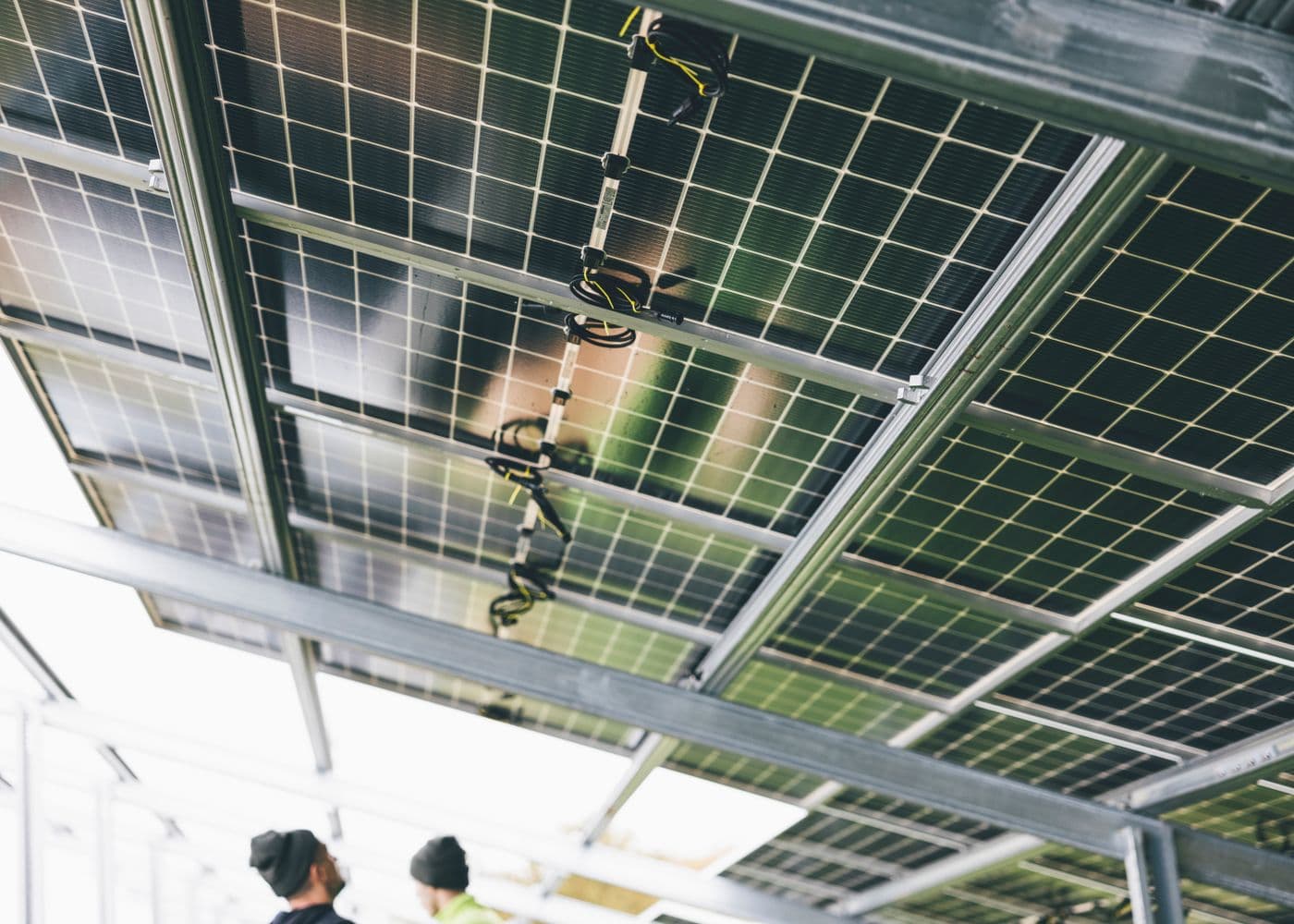
Solar sizing should begin with the appliances and routines the finished van must support. Photo: Kampus Production / Pexels.
Check the electrical match
For every proposed series string:
- add the panels' open-circuit voltages;
- apply the data-sheet temperature coefficient for the coldest expected condition;
- keep the result below the MPPT controller's absolute input limit with suitable margin;
- confirm operating voltage remains inside the controller's tracking range;
- check short-circuit current, parallel-string protection and connector ratings;
- confirm the controller's allowed PV power for the battery voltage.
Mixing unmatched panels in series can reduce the string to the weaker current. Parallel mismatches also need analysis. Identical modules are simpler, but roof shading may still justify separate controllers.
Mounting and heat
Use the panel and mounting-system instructions. A rigid panel normally benefits from airflow, but the required clearance and fixing method come from the selected hardware. For bonded flexible modules, substrate preparation, adhesive pattern and heat behavior are critical; do not improvise a fully sealed installation if the manufacturer requires otherwise.
Every roof penetration needs an appropriate weatherproof detail and periodic inspection. Adhesive-only mounts need verified material compatibility, surface preparation and load design.
Warranty questions worth asking
- Is mobile or vehicle-roof installation covered?
- Is the warranty for the product, power output or both?
- Who handles the claim in the UK?
- Must the panel be returned, and who pays freight?
- Does adhesive installation affect eligibility?
- Is the exact mounting method documented?
Save the data sheet, warranty and invoice for the model you actually receive.
Verdict
Choose a rigid framed monocrystalline panel from a supported supplier for most fixed-roof campervans. Choose flexible or CIGS only when curvature, profile or weight makes its compromises worthwhile. In every case, the winning model is the one that passes the roof-fit drawing, cold-voltage calculation and mounting/warranty checks.
Related
Frequently Asked Questions
Keep the build moving
Make the next build decision easier.
Get practical diagrams, calculator updates and honest product comparisons in your inbox.
Roam Wired
Roam Wired turns campervan research into practical plans. We publish transparent guidance, a free electrical design tool and marketplace resources for UK and US van builders.
About our approach